Citrus Pulp: Product Definition and Commercial Context
What Citrus Pulp Is
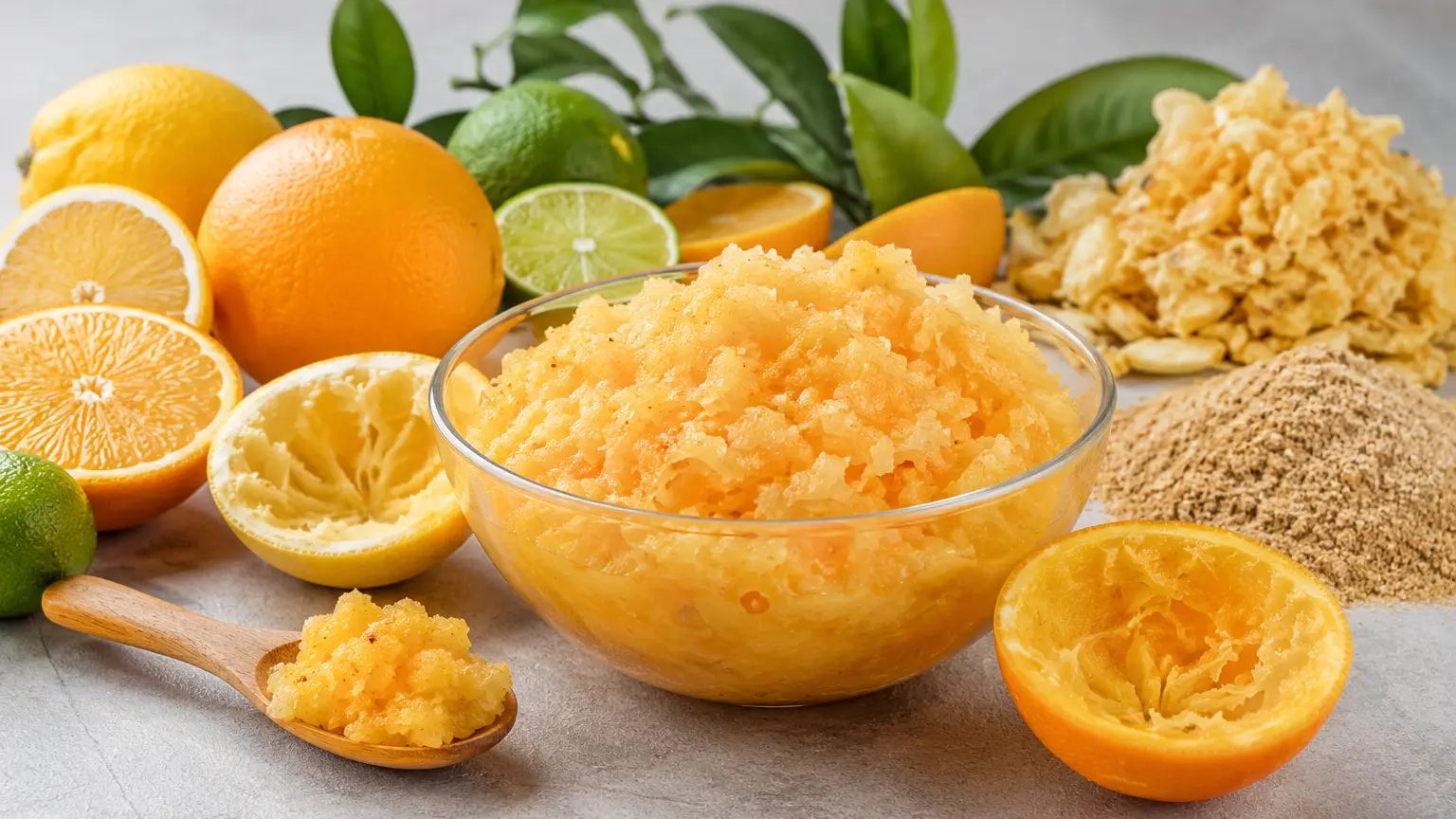
Citrus pulp is a by-product generated during juice production from citrus fruits including oranges, tangerines, mandarins, lemons, limes, and grapefruits. The Tradeasia product specification identifies Citrus Pulp as originating from the United States, with CAS Number 94266-47-4 and HS Code 230800. The listed material is a white to off-white solid and is categorized as a by-product, establishing its commercial position within agricultural and feed-ingredient supply chains. Tradeasia also identifies the material as a pure-substance product and provides technical documentation through its product platform.
From a sourcing perspective, citrus pulp is particularly relevant because its commercial value is connected to the utilization of material generated by citrus processing. Feedipedia describes citrus pulp as the solid residue remaining after juice extraction and notes that dried citrus pulp is commonly traded because drying improves handling, storage, and transportation compared with fresh pulp. This distinction is important for international procurement because product form can influence logistics, storage requirements, freight economics, and the practical distance between producer and end user.
Production and Physical Form
The Tradeasia manufacturing description indicates that production involves reducing water content to approximately 11%, adding lime to neutralize acidity and release water, pressing to remove excess moisture, drying the resulting pulp, and subsequently pelleting and cooling it. This processing sequence is commercially significant because moisture management and pelleting can make the material easier to handle as a traded feed ingredient. For procurement teams, understanding how the material is processed provides useful context when comparing specifications from different suppliers.
Technical information from Feedipedia similarly indicates that dried citrus pulp is easier to transport and manage than fresh pulp, while pelleting can improve bulk density, handling efficiency, dust control, and storage performance. Consequently, buyers evaluating dried citrus pulp should look beyond the product name and consider physical specifications, moisture management, packaging, pellet characteristics, documentation, and transportation conditions as part of the total procurement decision.
Citrus Pulp Applications in Ruminant Feed
Citrus Pulp for Dairy and Beef Cattle
The principal commercial application identified for Tradeasia's Citrus Pulp is animal nutrition. The product page specifically positions dried citrus pulp as a concentrated feed nutrient source for dairy cattle and beef cattle and describes it as an energy source that is readily mixed with other feed ingredients. This makes citrus pulp relevant to compound-feed manufacturers, livestock nutrition businesses, feed traders, and farm procurement teams seeking alternative feed resources for ruminant diets.
Scientific literature supports the broader application of citrus by-products in ruminant nutrition. A review in Animal Feed Science and Technology describes citrus by-products as useful high-energy feed resources in ruminant rations and discusses their potential role in supporting growth and lactation. The nutritional value of citrus by-products can vary according to fruit source and processing method, reinforcing the importance of specification-based purchasing rather than treating every citrus pulp supply as identical.
Citrus Pulp for Sheep and Ruminant Diets
Sheep represent another relevant buyer and end-use group. Tradeasia identifies sheep alongside dairy and beef cattle as an application for dried citrus pulp, while scientific research has examined citrus by-products in ruminant diets for their nutritional contribution. The commercial opportunity therefore extends beyond a single livestock segment and includes feed businesses supplying different ruminant production systems.
Recent scientific research also illustrates why application-specific evaluation remains important. A 2026 study published in Animals examined citrus pulp as an alternative energy source for high-yielding dairy cows and found that published results concerning digestibility can vary between studies. This reinforces a central sourcing principle: citrus pulp should be evaluated according to its actual specification, inclusion strategy, formulation requirements, and intended animal application rather than on a generic assumption about performance.
Market Trends Driving Citrus Pulp Demand
Circular Use of Citrus Processing By-Products
One of the most important market trends affecting citrus pulp is the broader movement toward agricultural by-product valorization. Citrus processing creates substantial residual biomass, and research has increasingly examined how these materials can be redirected toward feed, food ingredients, extraction of valuable compounds, and other applications. For B2B buyers, this means citrus pulp sits within a wider resource-efficiency conversation rather than functioning solely as a conventional feed commodity.
The Food and Agriculture Organization of the United Nations identifies citrus as a major global fruit crop cultivated across more than 140 countries, with oranges, lemons, tangerines, and grapefruits among the principal types. FAO also notes that citrus is traded and consumed as fresh fruit, juice, or concentrate. A large and geographically distributed citrus-processing ecosystem creates an underlying industrial base from which citrus by-products can enter secondary markets.
Growing Interest in Resource Efficiency
Recent research demonstrates that citrus processing residues are attracting interest beyond traditional animal-feed applications. A 2022 scientific review describes citrus processing waste as a potential source of pectin, essential oils, polyphenols, carotenoids, dietary fiber, and other valuable compounds, with potential applications across food and non-food sectors. This expanding valorization landscape can influence how processors and traders view residual citrus material and may create additional commercial pathways for suitable fractions.
For citrus pulp buyers, however, broader valorization does not mean every grade is interchangeable across industries. Feed applications require appropriate nutritional and physical characteristics, while extraction-oriented applications can require entirely different specifications. The commercial trend is therefore toward more purposeful segmentation of citrus-derived materials according to application, processing route, quality, and economics.
Key Buyers and Procurement Intent
Who Buys Citrus Pulp
The most relevant citrus pulp buyers are businesses involved in livestock feed manufacturing, feed distribution, agricultural commodity trading, animal nutrition, and commercial livestock production. Dairy-feed manufacturers may assess citrus pulp as an energy-oriented feed ingredient, while beef and sheep-feed businesses can evaluate it as part of broader ration formulation strategies. Traders and distributors may also source dried material for regional or international resale where logistics and market demand support commercial movement.
Buyer intent is typically specification-driven rather than purely informational. A procurement team searching for a “citrus pulp supplier” or “citrus pulp for animal feed” is likely evaluating commercial availability, product origin, technical documentation, physical form, quantity, shipping options, and supplier responsiveness. This makes citrus pulp a strong B2B marketplace category because product discovery can transition directly into supplier inquiry when technical and commercial information is sufficiently clear.
What Procurement Teams Evaluate
Before buying citrus pulp, procurement teams generally need to establish whether the material matches the intended feed formulation and operational requirements. Key considerations include product identity, origin, moisture characteristics, physical form, processing method, documentation, quantity availability, packaging, storage requirements, logistics, and consistency between shipments. The Tradeasia product page provides a technical-data and material-safety-document pathway and allows buyers to submit quantity, unit-of-measure, email, and message details as part of an inquiry.
Scientific literature further demonstrates why product characterization matters. Research has found that the composition of citrus by-products can vary according to fruit origin, cultivar, environmental conditions, processing techniques, dehydration methods, and extraction procedures. Consequently, buyers comparing citrus pulp suppliers should assess actual technical specifications and supporting documents rather than relying only on a commodity name.
Citrus Pulp Sourcing and Supplier Evaluation
Assessing a Citrus Pulp Supplier
A reliable citrus pulp supplier should provide enough information for a buyer to determine whether the material fits its application and procurement requirements. Product origin, identification, physical appearance, processing information, technical documentation, and commercial inquiry mechanisms are useful starting points. For international buyers, these factors should be considered alongside quantity, shipping requirements, lead times, packaging, and the supplier's ability to coordinate cross-border transactions.
The Citrus Pulp supplier information available through Tradeasia identifies the product's U.S. origin, CAS Number, HS Code, physical appearance, manufacturing process, and technical-document availability. The same page provides an inquiry mechanism for pricing, customization, shipping, and quantity discussions, making it relevant for buyers moving from initial product research toward commercial sourcing.
Managing Quality and Supply Risk
Supply-chain risk is particularly relevant for agricultural by-products because material characteristics can be affected by the originating fruit and processing conditions. Feedipedia notes that fresh citrus pulp is highly perishable because of its water and soluble-sugar content, while dried citrus pulp offers improved storage and international transport characteristics. This is one reason dried forms can be commercially attractive to buyers that need more manageable inventory and logistics.
Quality management should also consider the intended formulation and storage environment. Research on citrus by-products has highlighted variability in nutritional composition and the importance of chemical characterization before determining suitable inclusion in animal diets. For B2B procurement, a practical approach is therefore to establish the required specification first, request appropriate technical documentation, verify commercial terms, and then compare suppliers on delivered value rather than headline price alone.
Commercial Positioning and B2B Supply Opportunities
Opportunities for Feed Manufacturers and Traders
Citrus pulp has commercial relevance because it connects a large fruit-processing ecosystem with the animal-feed sector. Its positioning as an energy-oriented ruminant feed ingredient gives feed manufacturers and distributors an opportunity to incorporate a citrus-derived by-product into their sourcing portfolios. At the same time, citrus pulp's by-product status aligns with broader efforts to extract greater economic value from agricultural processing streams.
For traders and distributors, the opportunity is closely tied to matching supply characteristics with buyer requirements. Geographic origin, dried form, processing, physical handling properties, available documentation, and shipment economics can all affect whether a particular citrus pulp supply is commercially viable. The role of a B2B marketplace is therefore not simply to display a product but to facilitate communication between buyers seeking defined specifications and suppliers able to address those requirements.
Tradeasia as a B2B Sourcing Entry Point
For procurement teams beginning a citrus pulp sourcing process, Tradeasia's marketplace positioning provides a structured starting point for product discovery and inquiry. The Citrus Pulp product page presents product identification, origin, application information, manufacturing context, and technical-document access while providing an inquiry pathway for quantity, pricing, customization, and shipping discussions. This combination supports buyers at the point where market research becomes a sourcing conversation.
The commercial value of this model is strongest when buyers use the available information to define their requirements clearly. A procurement team can use the product information as an initial reference, then communicate expected quantities, unit requirements, application context, documentation needs, and logistics considerations through the inquiry process. This helps turn a broad search for a “citrus pulp supplier” into a more structured B2B procurement discussion.
Conclusion: Building a Reliable Citrus Pulp Supply Strategy
From Application Research to Procurement
Citrus pulp is commercially relevant as a citrus-processing by-product used primarily as a feed ingredient for ruminant applications, particularly dairy cattle, beef cattle, and sheep. Its energy contribution, handling characteristics, and compatibility with feed formulations make it a material of interest to feed manufacturers, livestock businesses, distributors, and commodity traders. At the same time, scientific evidence indicates that citrus by-product composition can vary, making application-specific evaluation important.
Market conditions also increasingly favor the productive utilization of agricultural by-products. FAO's description of the global importance of citrus production, combined with continuing research into citrus-waste valorization, demonstrates the broader industrial context surrounding these materials. For buyers, this creates a sourcing environment in which availability, specification, application suitability, logistics, and supply reliability need to be evaluated together.
Building a Reliable Citrus Pulp Supply Chain
The strongest procurement strategy is therefore based on specification clarity and supplier comparison. Buyers should establish the intended application, identify the required physical and technical characteristics, review available documentation, evaluate quantity and logistics, and compare suppliers on consistency and overall commercial suitability. These steps can reduce the risk of purchasing a material that does not align with the buyer's formulation or operational requirements.
For manufacturers, distributors, traders, and procurement teams evaluating citrus pulp, the Citrus Pulp sourcing page provides a practical starting point for reviewing product information and initiating a commercial inquiry. As citrus processing continues to generate valuable by-product streams and feed businesses seek diverse, commercially viable ingredient sources, structured B2B sourcing can help connect suitable citrus pulp supply with qualified industrial demand.
Leave a Comment