Citrus Pulp and Its Commercial Position in Feed Supply
What Citrus Pulp Is
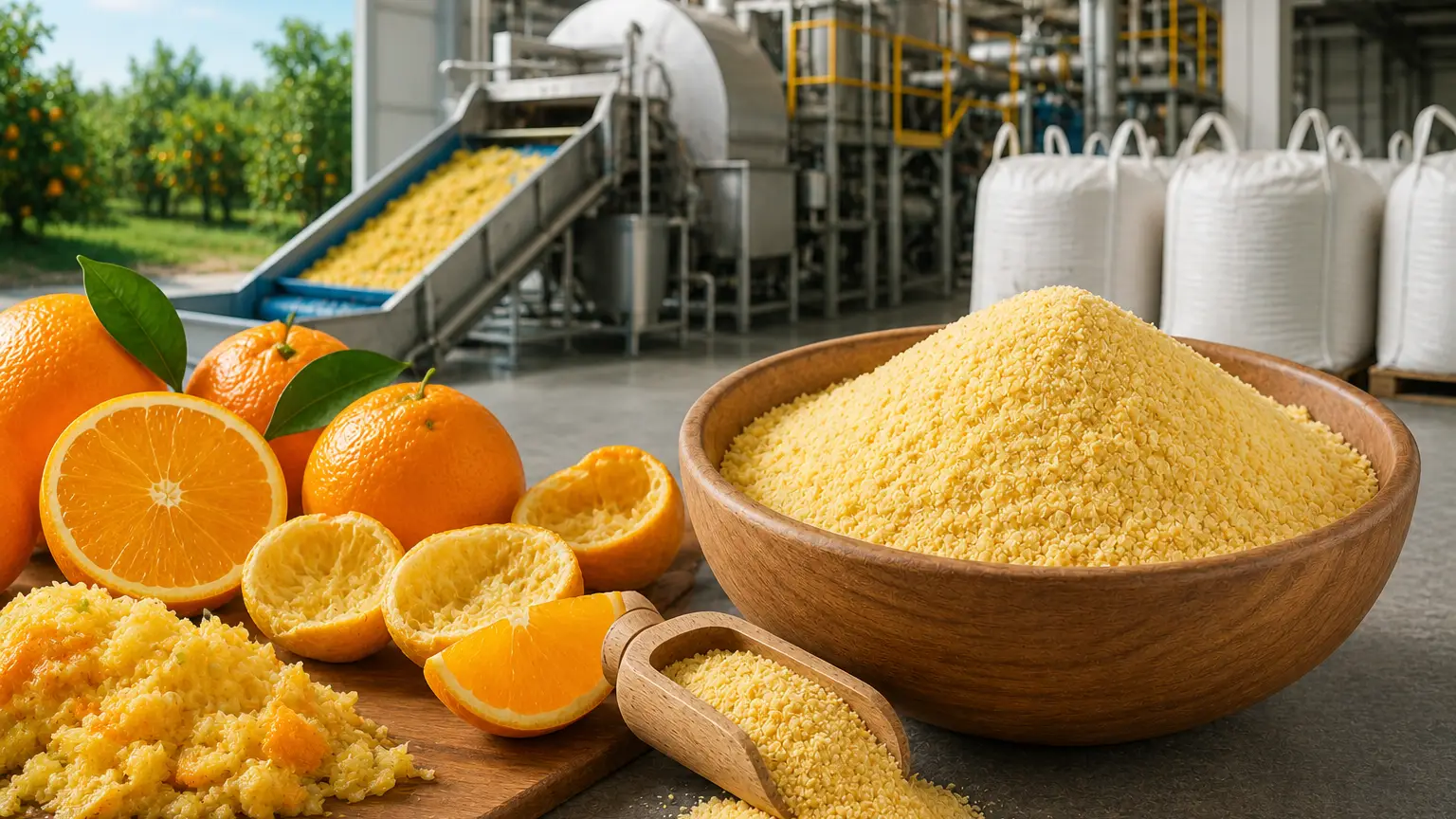
Citrus pulp is a by-product generated during the processing of citrus fruits such as oranges, tangerines, mandarins, lemons, limes, and grapefruits. The product information provided by Feedingredients Asia identifies Citrus Pulp as a U.S.-origin material with CAS Number 94266-47-4 and HS Code 230800. It is described as a white to off-white solid and categorized as a by-product.
From a commercial perspective, citrus pulp is particularly relevant to the animal-feed supply chain because citrus processing creates a material that can be recovered and converted into a usable feed ingredient. The product page describes dried citrus pulp as a concentrated feed nutrient source for dairy cattle, beef cattle, and sheep, with energy and calcium as notable nutritional characteristics.
The technical profile also makes citrus pulp relevant to feed formulators looking beyond conventional grain ingredients. Scientific literature has long examined citrus by-products as alternative feedstuffs, particularly because ruminants can utilize their fermentable and fibrous components.
For B2B procurement teams, this means citrus pulp should be viewed not simply as an agricultural residue but as a traded feed ingredient whose commercial value depends on processing, specification, storage stability, logistics, and suitability for the intended feed formulation. These factors create opportunities for manufacturers, traders, distributors, and livestock-feed buyers seeking diversified sourcing channels.
Key Industrial Applications of Citrus Pulp
Ruminant Feed Applications
The most established industrial application for dried citrus pulp is livestock nutrition, particularly ruminant diets. The product information positions it as a source of energy and calcium for dairy cattle, beef cattle, and sheep, while scientific reviews have documented the use of citrus by-products in ruminant feeding systems.
Citrus pulp can be incorporated into feed formulations where its nutrient profile complements other ingredients. Research on lactating Holstein cows found that dried citrus pulp could be incorporated into diets without detrimental effects on dry-matter intake or nutrient digestibility under the tested conditions, demonstrating why it continues to attract interest among animal-nutrition researchers and feed formulators.
Its use is not limited to dairy production. Research involving feedlot steers has investigated fresh citrus pulp as an energy source, while studies of dehydrated orange pulp have also assessed its potential in pig diets. These applications demonstrate that citrus-derived feed ingredients can attract interest across different livestock segments, although formulation suitability depends on the particular product form and feeding system.
For commercial buyers, application suitability should therefore be established against the actual feed specification rather than assumed from the generic product name. Product form, moisture level, processing method, nutrient profile, storage requirements, and compatibility with the buyer's feed formulation can all affect purchasing decisions.
Market Demand and Emerging Feed Trends
Sustainability and Feed Diversification
Interest in citrus pulp is closely connected to a broader movement toward agricultural by-product utilization and feed-resource efficiency. A 2022 scientometric analysis found that research concerning citrus waste as livestock feed had been expanding, with the field showing annual research-output growth of 10.20% over the period analyzed. The study also identified citrus pulp and pectin among prominent recurring research keywords.
This research direction reflects a commercial trend toward evaluating alternative feed ingredients that can reduce dependence on conventional feed resources while creating productive outlets for food-processing co-products. Citrus pulp fits this model because its origin in citrus juice processing connects the feed industry with an existing agricultural processing stream.
Recent research also continues to examine the role of citrus pulp in livestock diets rather than treating it solely as a waste-management solution. A meta-analysis published in 2024 evaluated citrus pulp inclusion in dairy-cow diets and examined its effects on milk performance and composition, with results varying according to inclusion level.
For buyers, the market opportunity therefore extends beyond simply finding the lowest-priced citrus pulp. Procurement teams increasingly need to consider consistency of supply, application performance, specification transparency, and the ability of suppliers to provide material that fits sustainability-oriented feed strategies. These considerations can strengthen demand for professionally managed B2B supply channels.
Buyer Intent and Procurement Considerations
Who Buys Citrus Pulp
The principal buyer groups include animal-feed manufacturers, compound-feed producers, livestock nutrition businesses, agricultural distributors, feed ingredient traders, and procurement teams serving dairy and beef operations. The product's relevance is strongest where buyers need energy-containing feed ingredients suitable for incorporation into livestock rations.
Buyer intent typically begins with an application question such as whether citrus pulp is suitable for cattle or dairy feed and progresses toward commercial questions involving specification, availability, packaging, shipment, pricing, and supplier reliability. This creates several interconnected B2B search intents around terms such as "citrus pulp supplier," "dried citrus pulp for animal feed," and "buy citrus pulp in bulk."
Procurement teams also need to distinguish between different physical forms of citrus pulp. Research and technical guidance describe fresh, pressed, and dried forms, with moisture content and storage characteristics affecting transportation economics and shelf-life considerations. The University of Florida's IFAS guidance, for example, highlights the substantial water content of fresh and pressed citrus pulp and the resulting importance of transport and preservation.
Supplier comparison is consequently an important part of citrus pulp procurement. Buyers can evaluate origin, technical documentation, processing method, physical form, nutrient specifications, packaging, logistics capability, and commercial terms before selecting a supply partner. For buyers seeking current product and supplier information, the Citrus Pulp product page provides a direct starting point for sourcing evaluation.
Sourcing Opportunities for B2B Buyers and Distributors
Evaluating Supply Reliability
Citrus pulp sourcing requires attention to both product quality and supply-chain execution. Because the material originates from citrus processing, availability can be influenced by fruit-processing volumes, production geography, processing practices, and the form in which the material is supplied. Historic FAO information on citrus by-products also emphasizes the importance of processing and drying in making citrus feed products easier to store, transport, and mix into compound feeds.
For international buyers, logistics can be particularly important. Dried material generally offers a different transportation profile from fresh or wet citrus pulp, making moisture and physical form important considerations when calculating delivered cost. Procurement teams should evaluate not only the quoted product price but also freight, handling, storage, documentation, and destination requirements.
Technical documentation is another important part of supplier qualification. The Feedingredients Asia product page identifies technical documentation including a Technical Data Sheet and Material Safety Data Sheet, alongside information about origin, appearance, manufacturing, and product characteristics.
For manufacturers and distributors, reliable sourcing can create opportunities to serve feed producers that need repeatable specifications and dependable delivery rather than one-off spot purchases. A B2B marketplace model can support this process by connecting commercial buyers with product information and inquiry channels, helping procurement teams move from initial research toward qualified supplier discussions.
Commercial Positioning and Supply Chain Outlook
Why Citrus Pulp Matters to B2B Buyers
Citrus pulp has commercial relevance because it connects two established value chains: citrus processing and animal nutrition. Its use as a feed ingredient provides processors with a productive outlet for citrus by-products while giving feed manufacturers another ingredient option for ration formulation. Scientific literature continues to examine its nutritional and sustainability implications, reinforcing its relevance to modern feed-resource strategies.
The strongest buyer opportunity is therefore concentrated among companies that can translate ingredient availability into consistent feed manufacturing value. Dairy-feed producers, beef-feed manufacturers, livestock nutrition businesses, distributors, and ingredient traders are particularly relevant because their purchasing decisions are influenced by application suitability, specification consistency, supply continuity, and delivered economics.
For Tradeasia and related B2B marketplace positioning, citrus pulp can serve as a commercial entry point for buyers researching alternative livestock-feed ingredients. Rather than relying on promotional claims, the marketplace proposition should emphasize accessible product information, technical documentation, inquiry support, and connections between buyers and supply-chain participants. Buyers can use the Citrus Pulp supplier information page as a starting point for reviewing the available product details.
Looking ahead, the combination of circular-economy thinking, livestock-feed diversification, and continued scientific evaluation of citrus by-products supports sustained commercial interest in citrus pulp. For procurement teams, the practical priority is to identify suppliers capable of meeting the required specification and logistics profile. For manufacturers, traders, and distributors, the opportunity lies in building dependable supply relationships around an ingredient with established feed applications and continuing relevance to resource-efficient animal nutrition. Buyers evaluating current supply options can begin with the Citrus Pulp product sourcing page and progress to an inquiry based on their application and procurement requirements.
Sources
- Frontiers in Research Metrics and Analytics — “Out-Look on Worldwide Trends of Related Studies on Citrus Waste as Feed for Livestock Production: A Scientometric Analysis” (2022). This source supports the discussion of research growth, sustainability, and evolving interest in citrus waste as livestock feed. Frontiers scientific article
- Animal — “The impact of replacing barley by dehydrated orange pulp in finishing pig diets on performance, carcass quality, and gaseous emissions from slurry” (2022). This peer-reviewed research supports the discussion of recent applications of dehydrated citrus pulp in animal nutrition. ScienceDirect research article
- Animal Feed Science and Technology — “The dietary application of dried citrus pulp, with or without soybean oil, in lactating Holstein cow diet” (2022). This research supports the discussion of dried citrus pulp in dairy-feed formulation and nutritional evaluation. ScienceDirect dairy-feed study
Leave a Comment