Choline Chloride 60% Corn Cob in the Feed Supply Chain
Choline Chloride 60% Corn Cob is a feed additive product listed by Feed Ingredients Asia, part of Tradeasia International, with China identified as the product origin, CAS Number 67-48-1, and HS Code 23099010. The product page classifies it under other additives and provides technical documentation, including a technical data sheet and safety data sheet. Its commercial relevance comes from its role as a choline source for animal nutrition, making it a procurement item for feed manufacturers and other businesses involved in animal nutrition supply chains.
Choline as a Feed-Nutrition Ingredient
Technical information on the product page describes choline as a low-molecular organic compound associated with maintaining physiological functions in animals and notes that it is commonly required in feed as an individual nutrient. The same source characterizes choline as having significant demand within the feed-additive category. This positions Choline Chloride 60% Corn Cob primarily within animal nutrition rather than general-purpose industrial chemical procurement.
The Significance of the 60% Corn Cob Format
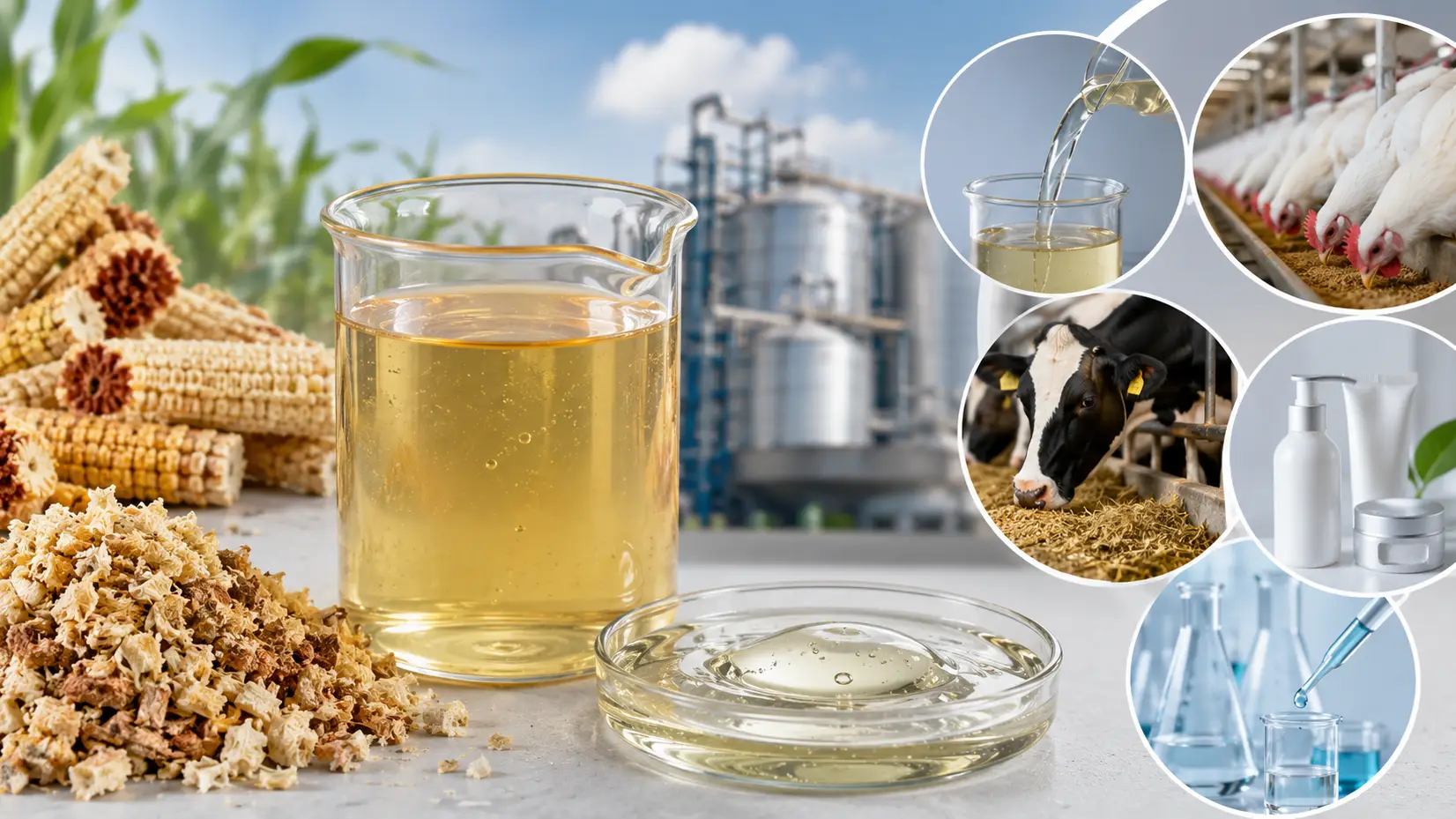
The product designation indicates a 60% Choline Chloride formulation using corn cob as the carrier format. The product information describes a manufacturing process in which concentrated Choline Chloride is mixed with a carrier before drying, producing a loose, crumbly material. For industrial buyers, understanding the product format is important because feed mills and premix manufacturers need ingredients that fit their formulation, handling and production processes.
The broader feed market gives this ingredient a substantial commercial context. FAO notes that feed is one of the most important inputs in intensive poultry production and that practical diets combine grains, protein sources, vitamins, minerals, amino acids and feed additives. This means procurement of nutritional additives such as Choline Chloride is connected to the larger requirement for dependable, technically suitable feed ingredients.
Industrial Applications and End-Use Demand
The clearest commercial applications for Choline Chloride 60% Corn Cob are animal-feed formulations, particularly poultry, swine and fish feed. The product page provides dosage information for broilers, laying hens, turkeys, swine and fish, demonstrating that the product is intended for use across multiple feed segments. For B2B buyers, this application breadth can make the product relevant to feed mills, premix producers, animal nutrition businesses and distributors serving different livestock markets.
Poultry Feed Applications
Poultry is a particularly important end-use segment because the product information specifies applications for broilers, laying hens and turkeys. The broader poultry industry is also a major consumer of manufactured feed. FAO describes poultry production as an increasingly industrialized sector and emphasizes the importance of feed formulation, nutrient availability and efficient nutrition. These conditions support continuing commercial relevance for nutritional feed additives used within poultry diets.
Swine and Aquafeed Applications
The product page also specifies application ranges for swine and fish, expanding its potential buyer base beyond poultry. This creates sourcing relevance for pig-feed manufacturers, aquaculture-feed producers and distributors supplying animal nutrition markets. Rather than treating Choline Chloride 60% Corn Cob as a single-purpose poultry ingredient, procurement teams can evaluate it against the needs of multiple feed-production categories.
The commercial significance of these applications is reinforced by recent global livestock trends. FAO reported in 2026 that global terrestrial animal-source food supply has increased substantially over the long term, with poultry showing particularly pronounced growth. As commercial animal production expands, feed manufacturers must continue securing appropriate nutritional inputs, creating an ongoing procurement environment for feed additives.
Market Trends Shaping Choline Chloride Procurement
The market outlook for Choline Chloride 60% Corn Cob is closely linked to the development of the global compound-feed industry rather than to isolated chemical demand. Alltech's 2025 Agri-Food Outlook estimated that global feed production increased by 1.2% in 2024, equivalent to an additional 16.7 million metric tons. Poultry remained especially significant, with poultry feed accounting for 42.7% of global feed tonnage in the report.
Growth in Global Feed Production
Rising feed output creates a broader addressable market for nutritional ingredients. The relationship is not a simple one-to-one increase between feed tonnage and Choline Chloride consumption, because inclusion rates depend on formulation requirements and animal species. Nevertheless, expanding commercial feed production increases the number of formulations, production cycles and procurement programs in which feed additives may be required.
Regional Feed Demand and Trade
Regional differences also matter to international sourcing. FAO's recent analysis of agrifood trade found that Asia's trade deficit has widened over time as reliance on imports to meet food and feed demand increased, particularly in China and India. The organization also identified growing feed demand as an important driver of trade in crops used for animal feed and processed feed products.
For Choline Chloride buyers, these trends point toward a procurement environment in which regional feed production, import dependence, transportation and supplier availability can influence purchasing decisions. Buyers therefore need more than a nominal product match: they need visibility into origin, documentation, commercial availability and logistics. This is particularly relevant for companies purchasing internationally rather than relying exclusively on domestic inventory.
Who Buys Choline Chloride 60% Corn Cob?
The primary buyer groups are feed manufacturers, premix producers, animal nutrition companies, distributors and agricultural ingredient traders. Feed mills can require Choline Chloride as part of formulated animal diets, while distributors may purchase the product for resale into regional livestock and aquaculture markets. The product's documented use in poultry, swine and fish feed creates several potential commercial routes to market.
Feed Manufacturers and Premix Producers
Feed manufacturers generally have the most direct application-driven purchasing requirement because they incorporate nutritional ingredients into compound-feed formulations. Premix producers are another important buyer group because they supply concentrated blends of nutritional ingredients to feed manufacturers. For these customers, consistency, technical documentation and predictable supply can be as important as the initial quoted price.
Distributors and Procurement Teams
Distributors and regional traders approach the product from a supply-chain perspective. They may need to compare origin, available volumes, shipment arrangements and customer specifications before committing to inventory. Procurement teams at larger feed businesses similarly need to balance formulation requirements with commercial considerations such as landed cost, lead time, supplier reliability and continuity of supply.
EFSA explains that feed additives are subject to scientific safety and efficacy assessment in the European Union and that authorization requirements apply before additives can be placed on the EU market. This illustrates why regulatory status and documentation can become part of the buyer's supplier-selection process, particularly when products cross borders into regulated feed markets.
What B2B Buyers Should Evaluate Before Sourcing
A commercial sourcing decision should begin with confirming that the offered product matches the intended application and purchasing specification. For Choline Chloride 60% Corn Cob, buyers should review the product identity, formulation, origin, technical documentation and intended feed use before comparing commercial quotations. The available Tradeasia product information identifies China as the origin and provides access to technical and safety documentation.
Product and Documentation Review
Documentation is particularly important for feed additives because specifications must align with the buyer's regulatory and quality requirements. Buyers should request the applicable technical data, safety documentation, product specification, certificate-of-analysis requirements and other documentation needed for their market. The product page itself provides links to a TDS and MSDS, giving procurement teams a starting point for technical review.
Supplier and Logistics Evaluation
Supplier comparison should extend beyond the quoted unit price. Procurement teams can evaluate origin, order quantities, packaging requirements, shipment lead time, export documentation, communication capability and consistency between shipments. These considerations become increasingly important when a feed manufacturer depends on imported material and cannot easily substitute an ingredient without reformulating production.
For buyers considering international procurement, the [Choline Chloride 60% Corn Cob product page](Choline Chloride 60% Corn Cob product page) provides a direct reference point for the product identity, origin, CAS number, HS code and available technical documentation. Using a defined product reference can help procurement teams structure supplier inquiries more efficiently and compare offers against the same commercial and technical baseline.
Building a Reliable Choline Chloride Supply Strategy
Reliable sourcing is especially important for ingredients that form part of recurring feed-production schedules. A feed manufacturer may need to purchase the same ingredient repeatedly across multiple production cycles, so supplier selection should consider continuity rather than a single transaction. This makes supply-chain capability an important component of Choline Chloride procurement.
Balancing Price and Supply Continuity
Lowest-price purchasing can create challenges if the supplier cannot maintain agreed specifications, shipment schedules or documentation. A more resilient approach compares total procurement value, including product suitability, logistics performance, lead time and supply consistency. For distributors, this can also affect inventory planning and their ability to serve downstream feed customers without interruption.
Using International Marketplace Sourcing
A B2B marketplace can help procurement teams organize supplier discovery and product evaluation by providing a structured commercial entry point. Tradeasia's Feed Ingredients platform presents Choline Chloride 60% Corn Cob alongside other feed ingredients and provides an inquiry route for buyers seeking pricing, customization and shipping information. This supports a sourcing workflow in which technical suitability is assessed before commercial terms are finalized.
Current feed-market conditions reinforce the value of supply planning. Alltech's 2025 outlook described global feed production as resilient despite disease outbreaks, economic pressures and climate-related challenges. For buyers, that resilience does not eliminate procurement risk; instead, it highlights the need for suppliers and buyers to coordinate around demand, inventory and logistics as feed production continues across changing regional conditions.
Commercial Outlook and Sourcing Opportunities
Choline Chloride 60% Corn Cob has a commercially relevant position within animal-feed procurement because its applications span poultry, swine and fish feed. The product page identifies specific application ranges for these animal categories, while broader industry data shows continued importance of poultry and other livestock production to global feed demand. For manufacturers, distributors and procurement teams, the opportunity is therefore closely connected to the continued professionalization and expansion of feed supply chains.
Application-Driven Demand
Application requirements will remain an important factor in future purchasing decisions. Poultry, swine and aquaculture producers have different formulation requirements, production systems and commercial priorities, so buyers need to match the product with the appropriate feed program rather than treating all demand as interchangeable. This application-driven approach creates opportunities for suppliers that can provide clear technical information alongside commercial sourcing support.
Market Opportunities for Suppliers and Distributors
Suppliers and distributors can position Choline Chloride 60% Corn Cob around dependable access to a recognized feed-additive format, transparent product information and international sourcing capability. The strongest commercial proposition is not simply availability; it is the combination of a defined product specification, relevant application knowledge and a procurement process that helps buyers evaluate supply options efficiently.
Looking ahead, international feed trade and animal-production growth should continue to influence the purchasing environment for nutritional ingredients. FAO's recent trade data highlights increasing inter-regional dependence in parts of the global food and feed system, while current feed-production data demonstrates the scale and resilience of the industry. For B2B buyers, this makes supplier diversification, documentation review and forward-looking procurement increasingly relevant.
For companies evaluating Choline Chloride 60% Corn Cob for recurring feed production or distribution, Tradeasia can serve as a commercial sourcing entry point. Buyers can review the [Choline Chloride 60% Corn Cob sourcing information](Choline Chloride 60% Corn Cob sourcing information) and use the available inquiry channel to discuss pricing, customization and shipping requirements. In a market where feed demand, regulatory expectations and international logistics all influence procurement, a structured supplier-evaluation process can help buyers make more informed sourcing decisions
Sources
Leave a Comment