Cashew Market Overview and Commercial Position
Cashew as a Globally Traded Food Ingredient
Cashew is an important internationally traded tree nut used both as a finished food and as an ingredient in processed products. Its commercial value extends beyond direct consumption because processors can incorporate cashew kernels into snacks, confectionery, bakery products and other prepared foods. The Codex Alimentarius Commission has been working toward a worldwide standard for cashew kernels, reflecting the importance of consistent quality, safety and fair practices in international trade.
From a B2B perspective, cashew procurement is closely connected with processing capacity, kernel specifications, origin, availability and end-market requirements. Buyers therefore typically evaluate more than the headline purchase price when selecting a supplier. Consistency of supply, product quality, documentation and the supplier's ability to meet agreed specifications can materially influence purchasing decisions.
2025/26 Supply Outlook
The International Nut and Dried Fruit Council estimated global raw cashew nut production at approximately 6.38 million metric tons for 2025/26, compared with approximately 5.37 million metric tons in 2024/25. The outlook indicates substantial production across West Africa, India, Cambodia and Tanzania, reinforcing the geographically diversified nature of the raw-material supply base.
This production landscape creates opportunities for international distributors and food manufacturers seeking dependable sourcing channels. At the same time, global availability does not automatically translate into uniform availability of particular kernel grades or specifications. Procurement teams must therefore connect market conditions with their exact application requirements before committing to bulk purchases.
Cashew Applications in Food Manufacturing
Snack and Ready-to-Eat Products
Cashew is widely suited to snack manufacturing because kernels can be sold directly after appropriate processing or incorporated into seasoned, roasted and mixed-nut products. Its recognizable flavor and texture allow manufacturers to position cashew as both a standalone ingredient and a premium component within broader snack formulations. This makes cashew relevant to processors serving retail, foodservice and private-label markets.
For industrial buyers, application requirements can determine the preferred kernel form and specification. Whole kernels may be desirable for premium presentation, while broken or smaller pieces can provide greater formulation flexibility in products where visual uniformity is less important. The choice ultimately depends on the finished-product design, processing method and target cost structure.
Bakery and Confectionery Applications
Cashew can also support bakery and confectionery formulations where nuts contribute texture, flavor and product differentiation. Manufacturers may incorporate cashew into cookies, cakes, chocolate products, nut bars and other prepared foods. These applications create demand from ingredient processors that purchase cashew in quantities suitable for repeated manufacturing runs rather than occasional retail consumption.
The commercial opportunity is particularly relevant for suppliers capable of providing predictable specifications across multiple shipments. Food manufacturers need ingredients that fit their production processes and quality-control systems, making dependable B2B supply an important consideration alongside price. This places cashew suppliers and distributors at an important point between agricultural production and industrial food manufacturing.
Cashew Demand Across Processing Industries
Food Processing and Ingredient Manufacturing
The industrial role of cashew is broader than its use as a packaged snack. Food processors can use cashew kernels as an ingredient in composite foods, nut mixes and specialty preparations, while ingredient manufacturers can further process kernels for incorporation into formulated products. Such applications create recurring procurement requirements and make reliable availability important for production planning.
Market demand is also influenced by geographic consumption patterns. INC reported that cashews represented 18% of global tree-nut consumption in 2024, while Asia accounted for 47% of total tree-nut consumption, followed by Europe at 30% and North America at 16%. These figures illustrate why suppliers targeting international buyers need to consider regional demand rather than viewing the cashew market as a single homogeneous segment.
Industrial Buyer Segmentation
Potential B2B cashew buyers include food manufacturers, snack producers, confectionery companies, bakery manufacturers, ingredient distributors, catering suppliers and foodservice operators. Each buyer group can have different expectations concerning kernel format, packaging, volumes, documentation and delivery schedules. A supplier's ability to understand these distinctions can improve the efficiency of commercial negotiations.
For distributors and marketplace buyers, sourcing flexibility is especially important because downstream customers may request different specifications. Maintaining access to multiple origins or processing partners can help distributors respond to changing demand while reducing dependence on a single supply channel. This is where a structured B2B sourcing platform can provide commercial value by connecting buyers with suitable supply options.
Cashew Buyers and Procurement Requirements
What B2B Buyers Evaluate
Cashew buyers generally need to assess product specifications before finalizing a purchase. Relevant considerations can include kernel style, size, appearance, moisture, foreign-material controls, packaging, shelf-life expectations and applicable food-safety documentation. The exact requirements vary according to the destination market and intended application, so procurement specifications should be established before commercial negotiations.
Regulatory alignment is increasingly important in international cashew trade. In 2026, Codex continued work on a proposed international standard for cashew kernels, with considerations covering quality, safety and related trade requirements. The development of such standards demonstrates the importance of harmonized expectations for producers, processors, importers and buyers.
Procurement Planning and Supplier Evaluation
A competitive cashew procurement strategy should consider both immediate purchasing requirements and longer-term supply continuity. Buyers may compare supplier origin, processing capabilities, commercial terms, logistics, documentation and historical performance before selecting a partner. Price remains important, but a lower quotation can become less attractive if inconsistent quality or delivery disruptions increase downstream manufacturing costs.
For recurring industrial demand, procurement teams should establish clear specifications and inspection procedures before shipment. Contract terms can then define acceptable quality parameters, packaging requirements and delivery expectations. This approach gives both buyer and supplier a clearer commercial framework and reduces the likelihood of disputes when shipments reach their destination.
Global Cashew Supply and Trade Dynamics
Major Production and Processing Regions
Cashew sourcing is supported by a broad international production base. The 2025/26 INC outlook identifies Côte d'Ivoire, Cambodia, India, Tanzania, Nigeria, Guinea-Bissau, Benin and Ghana among significant producing markets, while Vietnam remains a major processing and kernel-export hub. The same outlook estimated Côte d'Ivoire's 2025/26 crop at 1.50 million metric tons and Cambodia's at 930,000 metric tons.
Trade flows demonstrate why origin and processing location should be considered separately. African producers supply substantial quantities of raw cashew nuts to processing centers, while Asian processors play a major role in transforming raw nuts into exportable kernels. Historical INC trade data also show Vietnam and India as dominant destinations for imported raw cashews and major participants in shelled-cashew trade.
Market Conditions and Trade Risks
Cashew markets can respond quickly to crop conditions, raw-material availability, processing costs, currency movements, tariffs and regional purchasing activity. INC's 2025/26 outlook reported stronger crop estimates overall but also highlighted regional differences, including a weaker Brazilian crop and increased output expectations in several African origins. These variations mean buyers should monitor supply developments rather than relying exclusively on historical purchasing patterns.
Trade policy can also influence landed costs and sourcing decisions. For example, tariff developments affecting tree nuts have changed during 2025 and 2026, demonstrating how regulatory decisions can alter market competitiveness. For international buyers, evaluating the complete landed cost—including freight, duties, handling and compliance requirements—can therefore provide a more accurate basis for supplier comparison than the product quotation alone.
Cashew Quality and Regulatory Considerations
Quality Parameters for Commercial Trade
Cashew quality is central to both buyer acceptance and downstream processing performance. Buyers can specify kernel style, size, color, defects, moisture and other quality characteristics depending on the intended product. Consistent grading helps manufacturers maintain predictable appearance and processing behavior across production batches.
International standardization remains an important industry issue. Codex's proposed work on cashew kernels specifically addresses minimum requirements, classification, defects, size, packaging, additives, contaminants, pesticide residues, hygiene and labeling. For B2B procurement teams, these areas provide a useful framework for developing supplier specifications even when individual markets impose additional requirements.
Food Safety and Documentation
Food manufacturers typically require traceability and documentation appropriate to their market and application. Depending on the transaction, buyers may request certificates of analysis, origin information, food-safety documentation, packaging details and other compliance records. These requirements should be clarified during supplier qualification rather than after an order has been placed.
The importance of documentation is particularly clear in international supply chains where cashew may move through several stages between agricultural production and final consumption. Strong supplier communication can help buyers verify specifications, confirm shipment documentation and manage import requirements. For distributors, maintaining organized documentation also supports efficient resale to downstream food manufacturers.
Cashew Sourcing Strategy for B2B Buyers
Building a Competitive Supply Model
Effective cashew sourcing begins with a clear understanding of the finished application. A snack producer may prioritize appearance and kernel integrity, while an ingredient manufacturer may place greater emphasis on consistency, availability and cost efficiency. Translating these needs into measurable purchasing specifications helps buyers compare suppliers on an equivalent basis.
Buyers should also assess supply continuity rather than focusing solely on one transaction. The international cashew market involves multiple production seasons and processing centers, creating opportunities to diversify sourcing. A supplier network that provides access to different origins and processing capabilities can help procurement teams manage fluctuations in raw-material availability.
Using B2B Marketplaces for Supplier Discovery
B2B marketplaces can simplify supplier discovery by bringing product information, commercial inquiries and sourcing opportunities into a structured environment. For buyers seeking cashew in commercial quantities, this can make it easier to identify suppliers that align with application, volume and destination-market requirements.
Tradeasia International operates across international chemical and ingredient supply networks, giving B2B buyers a platform-oriented route for evaluating sourcing opportunities. For cashew procurement, the practical objective is not simply finding a quotation, but developing a supply relationship that balances product suitability, commercial competitiveness, documentation and delivery reliability.
Conclusion: Building Reliable Cashew Supply
Cashew's Role in B2B Food Markets
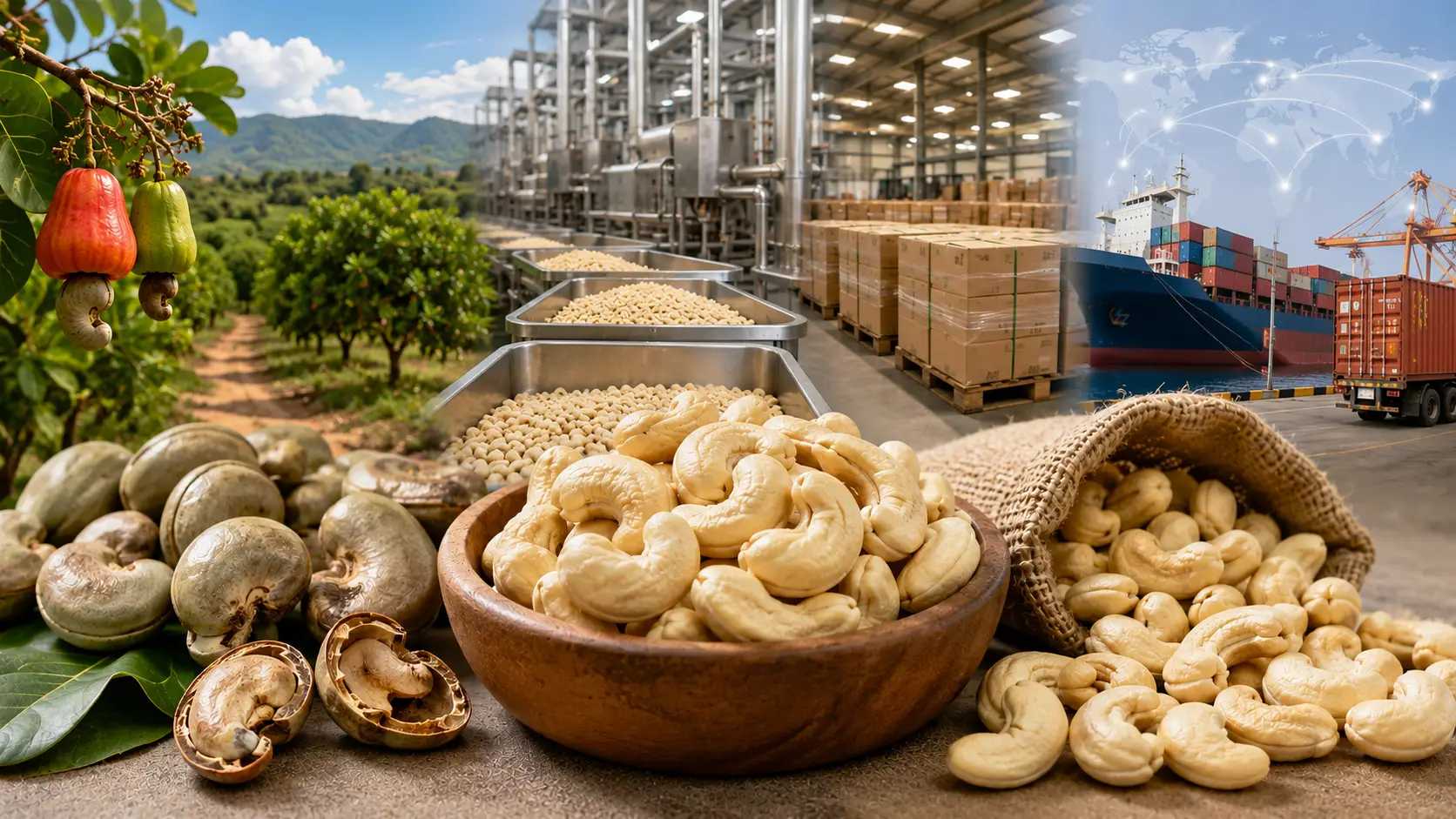
Cashew remains commercially relevant across snacks, bakery, confectionery and broader food-processing applications. Its international supply chain connects agricultural producers, processors, exporters, distributors and food manufacturers, creating a market in which quality specifications and supply reliability are as important as price. The 2025/26 production outlook indicates a large global raw-material base, while continuing trade and regulatory developments keep procurement conditions dynamic.
For buyers, the most effective approach is to define the intended application first and then match kernel specifications, supplier capabilities and logistics requirements to that application. This helps procurement teams reduce unnecessary specification gaps and make supplier comparisons more meaningful. It also supports stronger planning when market conditions or regional availability change.
Supporting Smarter Global Sourcing
As international food supply chains become increasingly interconnected, buyers benefit from sourcing partners that can combine product understanding with commercial and logistics coordination. A structured procurement process can improve visibility into available supply, specifications, documentation and delivery expectations while supporting more consistent purchasing decisions.
Tradeasia International can serve as a commercial sourcing channel for businesses exploring international supply opportunities and building dependable B2B procurement relationships. For food manufacturers, distributors and procurement teams, the priority is ultimately to secure cashew supply that fits the application, meets required specifications and supports reliable production planning.
Sources
https://www.fao.org
https://www.ers.usda.gov
https://www.fao.org
Leave a Comment