Cashew Market and Commercial Relevance
Cashew as a Global Food Commodity
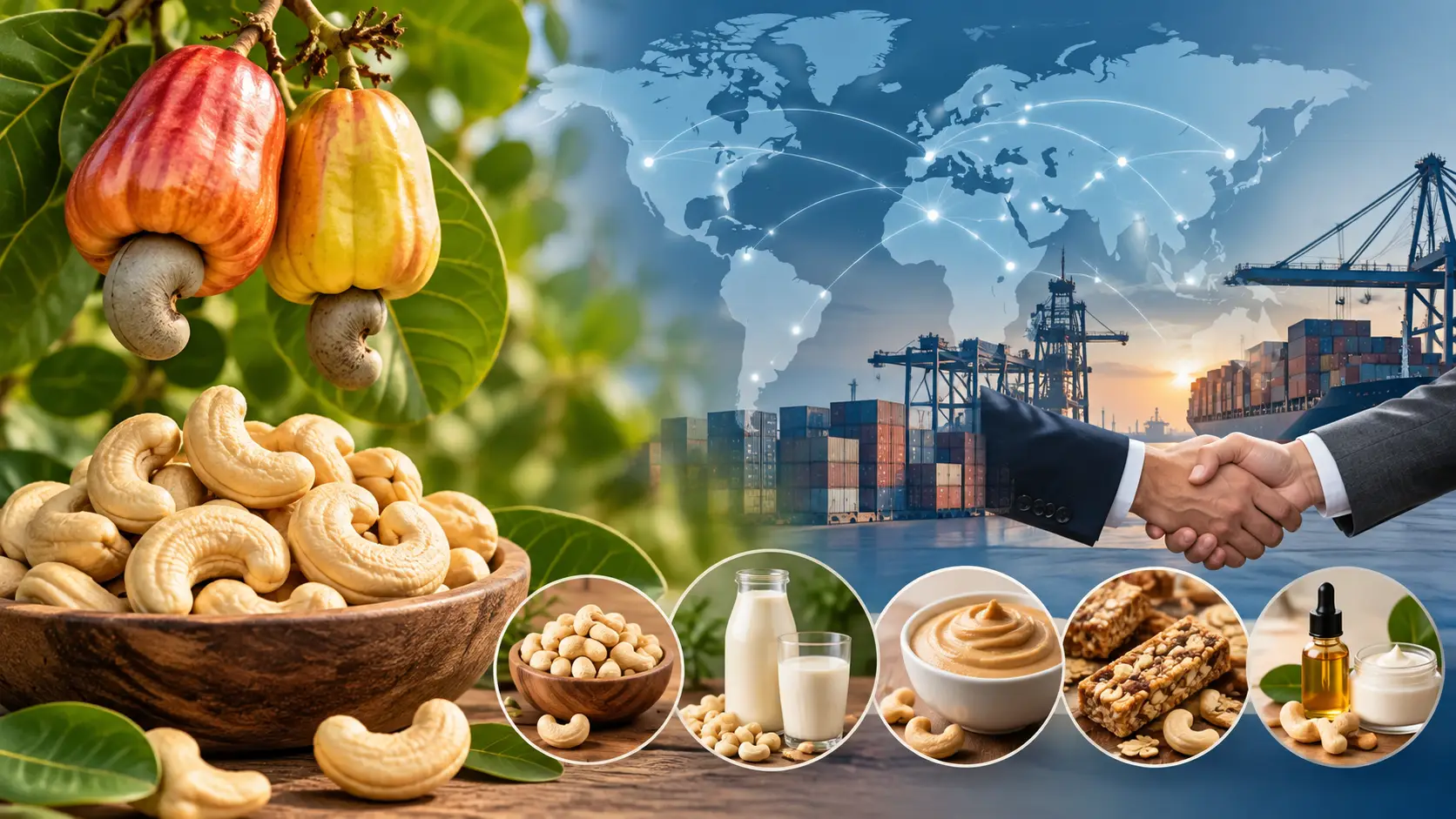
Cashew is an important agricultural commodity traded across international food markets, with cashew kernels serving as a significant commercial product for food manufacturers, processors, distributors, wholesalers, and retailers. Its combination of distinctive flavor, texture, and versatility allows it to serve both direct-consumption and ingredient applications. For B2B buyers, the commercial value of cashew is therefore closely connected to kernel quality, processing capabilities, product specifications, packaging, and dependable supply.
The international cashew sector also has an established value-chain structure extending from agricultural production and collection through processing, packaging, distribution, and end-market consumption. FAO's value-chain research on West African cashew specifically examines production inputs, processing, markets, governance, sustainability, and the competitive position of processing activities. This makes cashew relevant not only as a finished food product but also as a sourcing category requiring coordination across multiple stages of the supply chain.
Growing Importance of Processed Cashew Products
Commercial opportunities increasingly extend beyond raw agricultural output toward processed and value-added cashew products. Processing can include activities such as drying, shelling, peeling, grading, roasting, packaging, and further transformation into ingredients and finished foods. FAO-linked value-chain documentation identifies shelling, drying, roasting, packaging, and cashew-apple processing among activities that can create additional value within the sector.
For international buyers, this creates several procurement pathways. A company may source processed kernels for direct packaging, roasted cashews for snack production, or kernels as ingredients for confectionery, bakery, spreads, beverages, and other food products. The appropriate sourcing model depends on the buyer's formulation, processing capability, required grade, target market, packaging requirements, and expected shipment volumes.
Cashew Processing and Product Forms
From Cashew Nut to Commercial Kernel
Cashew kernels are obtained through processing of the cashew fruit and seed. The processing chain can involve drying, steaming or roasting, shell removal, peeling, grading, and packaging before the product reaches commercial buyers. Codex documentation describes cashew kernels as products obtained from suitable varieties of Anacardium occidentale and recognizes whole, split, and broken presentations as relevant commercial forms.
The processing format has a direct effect on the commercial application of the product. Whole kernels can be particularly relevant to snack packs, premium nut mixes, and decorative food applications, while broken or split kernels may be suitable for applications where the visual appearance of individual kernels is less important. Buyers therefore need to match product form with the technical and commercial requirements of their final product.
Grading, Packaging and Handling
Cashew procurement involves more than simply specifying the commodity name. Buyers may need to define kernel style, size, appearance, moisture-related specifications, defect tolerances, packaging format, and handling requirements according to their intended application. The proposed Codex work on cashew kernels specifically identifies quality, defects, sizes, tolerances, packaging uniformity, contaminants, pesticide residues, hygiene, and labelling as areas relevant to an international standard.
For B2B sourcing, standardized specifications can make supplier comparisons more practical. Procurement teams can evaluate offers against consistent product requirements rather than relying only on a nominal product description. This approach also supports quality assurance, production planning, import documentation, and downstream customer requirements, particularly when cashew is purchased in recurring commercial volumes.
Cashew Applications in Food Manufacturing
Cashew in Snacks and Consumer Foods
One of the most established applications for cashew is direct consumption as a snack ingredient or finished nut product. Cashew kernels can be sold raw or processed through roasting and seasoning, then incorporated into packaged snack products, nut mixes, trail mixes, and premium food assortments. Their recognizable flavor and texture also allow manufacturers to position them as an ingredient in differentiated consumer products.
For industrial buyers, snack production creates requirements that differ according to the finished product. Whole kernels may be selected where appearance is important, while pieces can be more appropriate for mixes or processed formulations. Consistent supply, controlled quality, appropriate packaging, and reliable specifications can therefore become important purchasing considerations when cashew is integrated into high-volume snack manufacturing.
Cashew in Bakery and Confectionery
Cashew also has applications across bakery and confectionery manufacturing. Kernels or pieces can be incorporated into cookies, biscuits, cakes, chocolate products, cereal bars, nut-based fillings, desserts, and other formulations. The ingredient can contribute texture, flavor, and visual differentiation while functioning alongside chocolate, sugar, flour, fats, dried fruits, and other food ingredients.
Cashew can also be processed into value-added formats such as nut butters and plant-based food products. Government value-chain documentation from Liberia, for example, identifies roasted cashews, cashew butter, and cashew milk as potential value-added products within the cashew sector. For manufacturers, these applications broaden the commercial opportunity beyond traditional whole-kernel snack products and create demand for different processing specifications.
Cashew Buyers and Procurement Requirements
Food Manufacturers and Processors
Food manufacturers represent an important buyer group because cashew can enter production as either a finished ingredient or an intermediate raw material. Snack manufacturers may prioritize whole or graded kernels, while confectionery and bakery processors may require pieces or specific sizes suited to mixing, filling, coating, or inclusion processes. Industrial processors may also seek larger and more consistent volumes for recurring production schedules.
Procurement teams typically need to connect product specifications with manufacturing requirements before selecting a supplier. Factors such as kernel form, grade, packaging, shelf-life expectations, documentation, shipment quantity, delivery schedule, and destination-market requirements can all influence purchasing decisions. A supplier capable of aligning these parameters with the buyer's production plan can provide greater practical value than a supplier evaluated only on quoted price.
Distributors, Wholesalers and Ingredient Traders
Distributors and ingredient traders have a different procurement focus because they may serve multiple downstream customers with different specifications. They may require a portfolio of cashew grades, pack sizes, and product forms that can accommodate snack producers, bakeries, confectionery manufacturers, foodservice companies, and retailers.
This makes supplier flexibility particularly relevant within B2B trade. Buyers can benefit from sourcing partners that provide clear specifications, consistent documentation, commercially practical packaging, and predictable logistics. International sourcing can also require coordination around customs documentation, shipment terms, inspection requirements, and destination-country food regulations, making supplier communication an important part of the purchasing process.
Cashew Quality and Supply Considerations
Quality Parameters for Commercial Buyers
Quality is central to cashew procurement because differences in kernel appearance, size, integrity, defects, moisture, hygiene, and handling can affect both manufacturing performance and finished-product presentation. International standard-setting work has specifically considered minimum requirements, classification, quality characteristics, defects, size, weight, broken kernels, additives, contaminants, pesticide residues, hygiene, and labelling for cashew kernels.
The regulatory landscape is also evolving. In 2026, Codex documentation continued work on developing a worldwide standard for cashew kernels, with the proposal covering questions around quality, safety, harmonization, and applicability to international trade. Buyers should therefore distinguish between established destination-market requirements, supplier specifications, customer specifications, and standards that are still under development.
Supply Chain Reliability
Reliable supply is another important consideration because cashew moves through a geographically distributed agricultural and processing network. Production, collection, processing, grading, packaging, storage, inland transport, export handling, and international shipping can all affect delivery performance. FAO's work on the West African cashew sector highlights the importance of understanding the complete value chain and the processing segment rather than viewing the commodity only at the farm level.
For buyers, supply-chain reliability can be assessed through supplier capacity, sourcing origin, processing capabilities, quality-control procedures, packaging systems, documentation, lead times, and logistics arrangements. A structured procurement process helps food manufacturers reduce uncertainty when integrating cashew into recurring production programs.
Cashew Sourcing and B2B Trade
Supplier Selection for International Procurement
Cashew sourcing should begin with a clearly defined commercial specification. Buyers can establish the desired product form, grade, kernel size, packaging format, quality requirements, target quantity, delivery location, and required documentation before requesting quotations. This creates a more consistent basis for comparing suppliers and reduces ambiguity during commercial negotiations.
A B2B marketplace can support this process by connecting buyers with suppliers and creating a structured environment for product discovery and procurement. For international food companies, sourcing platforms can be useful when they need to compare product availability, supplier capabilities, commercial terms, and application suitability across different supply channels.
Managing Procurement Across Markets
International cashew procurement also requires attention to the relationship between origin, processing location, destination market, and logistics route. A supplier may source agricultural material from one producing region while processing, grading, and packaging the kernels elsewhere. Understanding these stages can help buyers assess lead times, traceability requirements, documentation, and potential supply-chain dependencies.
Tradeasia / Chemtradeasia / Tradechem Marketplace can serve as a B2B sourcing environment for businesses seeking connections within international ingredient and commodity markets. For procurement teams, the objective is to identify suppliers that can meet technical specifications while also supporting the commercial requirements of volume purchasing, documentation, packaging, logistics, and repeat orders.
Cashew Market Opportunities and Value Addition
Moving Beyond Raw Commodity Trading
Value addition is an important theme within the cashew sector because processing can create products suited to different market segments. Instead of trading only raw cashew material, businesses can participate in processing, grading, roasting, packaging, ingredient preparation, and finished-product manufacturing. FAO's recent work in Guinea-Bissau, for example, emphasizes improved production practices, local processing, sustainability, and income diversification within the cashew value chain.
For B2B buyers, value-added sourcing can provide access to materials more closely aligned with production requirements. Instead of purchasing a basic commodity and carrying out every processing step internally, a manufacturer may source a prepared kernel grade or processed cashew ingredient that is closer to its manufacturing specification. This can influence equipment requirements, labor needs, production efficiency, and procurement planning.
Opportunities Across Food Categories
Cashew's broad food applications create commercial opportunities across snacks, bakery, confectionery, nut spreads, desserts, plant-based products, and other processed foods. The ability to use different kernel forms also supports multiple manufacturing models, from visually premium whole kernels to smaller pieces incorporated into formulations.
Market development is consequently linked to both consumer demand and industrial innovation. Buyers looking for new product concepts can evaluate cashew according to application, processing format, target consumer, and manufacturing economics. Suppliers, meanwhile, can strengthen their market position by presenting clear technical specifications and identifying the food categories in which their cashew products are suitable.
Conclusion: Building Reliable Cashew Supply Strategies
Connecting Applications With Buyer Needs
Cashew is commercially relevant because it combines established food applications with opportunities for processing and value addition. Its use across snacks, bakery, confectionery, spreads, desserts, and other food categories means that buyers may require different kernel forms, grades, processing levels, and packaging configurations. Effective procurement therefore starts by connecting the intended application with an appropriate product specification.
For procurement professionals, the most useful approach is to evaluate cashew as part of an integrated supply chain rather than as a standalone agricultural commodity. Product quality, processing capability, supplier consistency, documentation, packaging, logistics, and destination-market requirements all contribute to the commercial suitability of a supply arrangement.
B2B Sourcing for the Cashew Supply Chain
The continued development of international standards and value-added processing highlights the importance of transparent and specification-driven trade. Codex work in 2026 demonstrates that international attention remains focused on developing a standardized framework for cashew kernels, particularly around quality, safety, and trade-related provisions.
For manufacturers, distributors, and ingredient traders, sourcing Cashew through a structured B2B marketplace can help connect application requirements with supplier capabilities. Tradeasia / Chemtradeasia / Tradechem Marketplace provides a commercial platform through which businesses can explore sourcing opportunities and develop supplier relationships for international food and ingredient procurement.
Sources
https://www.fao.org
https://www.fao.org
https://www.fao.org

Leave a Comment