Canola Meal Market Position and Supply Fundamentals
What Canola Meal Is and Why It Matters
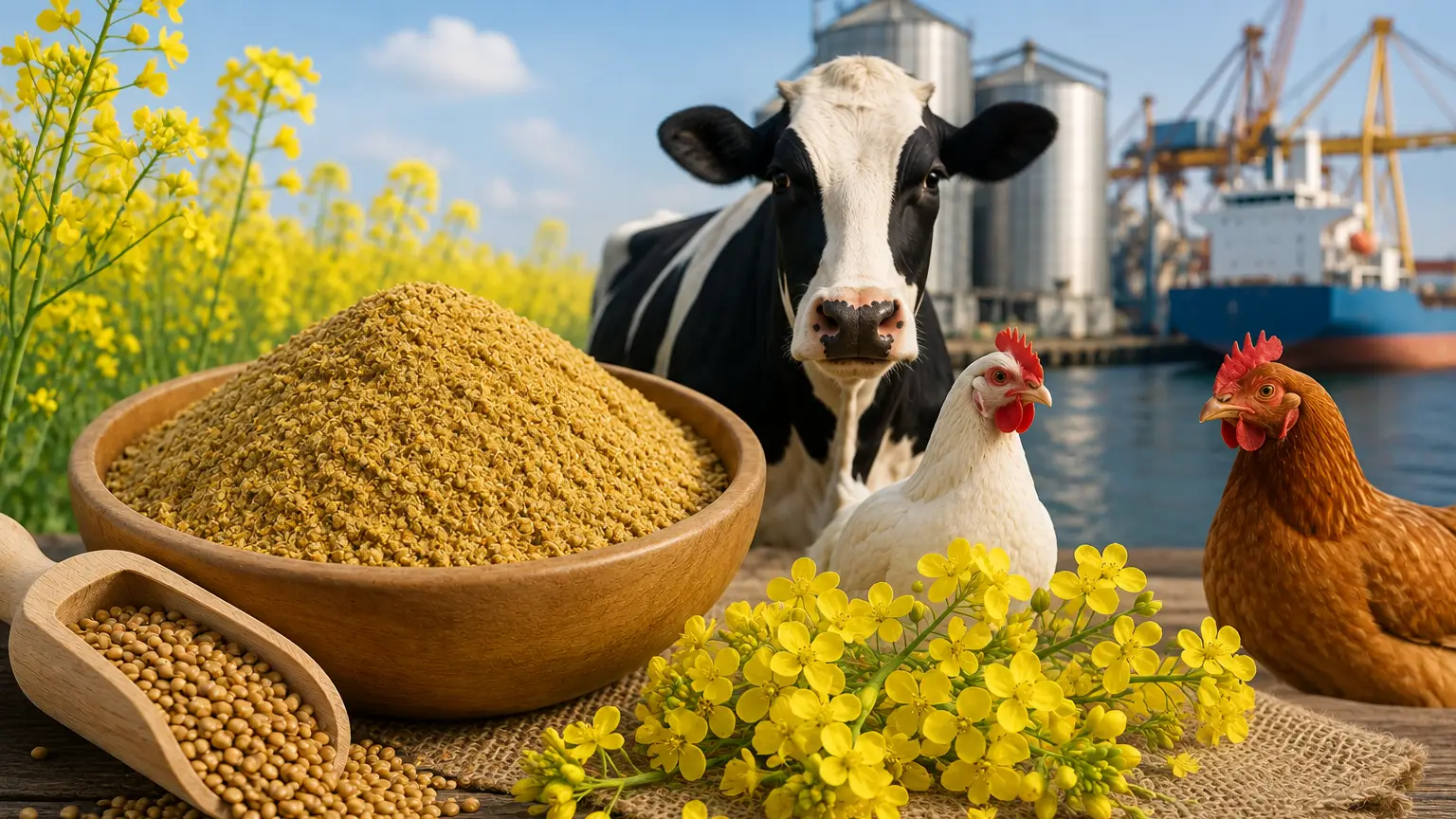
Canola meal is a protein-rich coproduct generated after oil is extracted from canola or rapeseed seed. The supplied Tradeasia product page identifies it as a feed-grade solid derived from Brassica napus, with a minimum crude protein specification of 36%, maximum crude fat of 2.5%, maximum crude fiber of 12%, and maximum ash of 7%. It is supplied in powder or pellet form and can be offered in 50 kg bags or bulk formats. These characteristics position canola meal primarily as a commercial protein ingredient for compound feed formulations rather than as a specialty chemical.
Protein Value in Feed Formulation
The commercial importance of canola meal comes from its combination of protein concentration, amino acid characteristics, and availability as a coproduct of a large oilseed-processing industry. The Canola Council of Canada reports that Canadian canola meal commonly contains substantially more protein than the minimum trading specification, while its technical information highlights useful levels of methionine and cysteine. This makes canola meal for animal feed relevant to nutritionists seeking alternatives or complements to other vegetable protein ingredients.
Supply Is Connected to Oilseed Processing
Canola meal supply is intrinsically linked to canola crushing and oil production. As oilseed processors extract oil, the remaining solids become a commercially valuable feed coproduct. The supplied product information describes a conventional process involving seed cleaning, conditioning and flaking, cooking, mechanical pressing, solvent extraction, desolventizing and toasting, followed by drying and cooling. For buyers, this means supply availability is influenced not only by feed demand but also by canola seed production, crushing activity, oil markets, processing capacity, and international trade.
Why Procurement Teams Track Specifications
A canola meal supplier therefore needs to be evaluated on more than nominal protein content. Buyers can assess moisture, protein, fiber, fat, ash, mineral composition, microbiological parameters, contaminants, packaging, shelf life, documentation, and delivery capability. The Tradeasia product specification lists moisture below 12%, Salmonella negative at 25 g, a six-month shelf life, feed-grade status, and ISO/HACCP credentials. These details provide a useful starting point for procurement teams developing supplier qualification criteria.
Canola Meal Applications Across Animal Feed Industries
Dairy and Ruminant Feed
Dairy cattle remain an important application for canola meal for animal feed because protein quality and rumen protein utilization are central to ration formulation. The Canola Council of Canada identifies dairy, other ruminants, poultry, swine, and aquaculture as key application areas, while its recent feeding research continues to investigate metabolizable protein supply and feeding value in dairy diets. For commercial buyers, this makes dairy feed an important demand segment where consistency in nutritional specifications can influence purchasing decisions.
Poultry Feed Applications
Poultry producers and feed manufacturers can incorporate canola meal as part of broader protein strategies. Its role is not simply determined by crude protein; formulation decisions also depend on amino acid supply, digestibility, fiber, energy contribution, and the nutritional characteristics of the complete ration. The 2024 Canola Meal Feeding Guide covers poultry alongside other livestock categories and reflects the industry's continuing work to improve understanding of canola meal utilization across species.
Swine and Aquaculture Feed
Swine and aquaculture represent additional applications where feed formulators can evaluate canola meal alongside other protein ingredients. The Canola Council's current technical guide includes both species and incorporates updated nutrient and digestibility information as well as research on a wider range of aquaculture species. This broadening technical base supports the positioning of canola meal applications beyond traditional ruminant feeding and creates opportunities for suppliers able to provide consistent material suitable for formulation trials and commercial feed production.
Application-Specific Buying Requirements
Different end users can place different priorities on the same ingredient. A dairy nutrition program may emphasize protein utilization and ration economics, while poultry, swine, and aquaculture formulators may focus more heavily on digestibility, amino acid balance, fiber, energy contribution, and species-specific inclusion considerations. Consequently, canola meal buyers should avoid treating one specification sheet as sufficient for every application and should align supplier documentation with the technical requirements of the intended feed formulation.
Market Demand and Regional Buyer Trends
Global Protein Meal Demand
The broader outlook for oilseed-derived protein meals provides an important context for canola meal market demand. The OECD-FAO Agricultural Outlook 2025-2034 states that most oilseeds and oil crops are processed into vegetable oil and protein meal, with protein meals primarily used in animal feed. The report expects protein meal utilization to remain closely connected to livestock-feed demand, while noting that international protein meal prices have recently been influenced by global supply conditions and oilseed-crushing activity.
Growth in Emerging Feed Markets
Demand conditions are particularly relevant in emerging economies, where rising incomes, urbanization, and increasing consumption of animal-source foods support longer-term requirements for livestock and aquaculture production. The OECD-FAO 2025 outlook projects global agricultural and fish production to increase through 2034 and expects meat, dairy, and egg production to expand. For suppliers, this creates a broader market environment in which feed manufacturers continue to assess cost-effective and nutritionally appropriate protein sources.
Southeast Asian Procurement Opportunities
Southeast Asia is commercially relevant because feed production and protein-meal imports are linked to expanding animal production. The OECD-FAO outlook identifies increasing animal production in Southeast Asia as a factor supporting demand for imported protein meal. This does not mean every country will experience identical purchasing patterns, but it does indicate an attractive regional context for canola meal supplier Asia strategies that connect processors and traders with compound-feed manufacturers, livestock integrators, distributors, and other professional buyers.
Supply Growth and Market Balance
Canola supply fundamentals also matter because meal availability is tied to crushing volumes. The Canola Council of Canada reports 21.8 million metric tonnes of Canadian canola production in 2025 and 11.6 million tonnes of domestic processing, with meal crude protein averaging 39.3% on an oil-free, 12%-moisture basis. The industry's continued investment in processing capacity illustrates how developments in the oilseed value chain can affect the medium-term availability of canola-derived feed ingredients.
What B2B Buyers Evaluate Before Sourcing Canola Meal
Nutritional and Physical Specifications
For canola meal procurement, the first stage is confirming that the material matches the intended feed formulation and applicable purchasing specification. Key parameters can include crude protein, crude fat, fiber, ash, calcium, phosphorus, moisture, bulk density, amino acid values, and physical form. The Tradeasia specification provides a commercial reference point with minimum protein of 36%, maximum fat of 2.5%, maximum fiber of 12%, calcium of 0.65%, phosphorus of 1.0%, and approximate bulk density of 0.55 g/cm³.
Safety and Quality Documentation
Feed buyers also need confidence that products meet their internal quality and regulatory requirements. Depending on the market and application, procurement teams may review microbiological results, mycotoxin limits, heavy-metal compliance, dioxin and PCB controls, certificates of analysis, traceability documentation, and food or feed safety certifications. The supplied product information includes microbiological specifications, an aflatoxin B1 limit, compliant heavy metals and dioxins/PCBs, and ISO/HACCP status, demonstrating the type of information buyers may expect during supplier evaluation.
Logistics and Commercial Terms
A technically suitable bulk canola meal supply can still be commercially unsuitable if logistics, packaging, lead time, minimum order quantities, storage requirements, or delivery terms do not match the buyer's operating model. Canola meal can be supplied in 50 kg PP woven bags or in bulk according to the supplied product page. Procurement teams should therefore compare not only quoted product prices but also freight, handling, port requirements, storage conditions, delivery schedules, documentation, and the supplier's ability to support repeat orders.
Comparing Suppliers
Buyers compare suppliers because protein ingredients are recurring inputs rather than one-time purchases. Consistency between shipments can influence feed formulation, inventory planning, production scheduling, and quality control. A practical canola meal sourcing process therefore considers specification compliance, documentation quality, supply continuity, responsiveness, logistics capability, and commercial flexibility alongside price. The product's canola meal product page can serve as an initial sourcing reference for specifications, packaging, certifications, and inquiry requirements.
Canola Meal Supply Opportunities and Commercial Positioning
Relevant Buyer Groups
The most relevant canola meal buyers include compound-feed manufacturers, dairy-feed producers, poultry-feed companies, swine-feed manufacturers, aquaculture-feed producers, livestock integrators, feed-ingredient distributors, agricultural traders, and procurement organizations. Their requirements can differ according to species, formulation strategy, production scale, and geographic market. A B2B marketplace can therefore create value by making product specifications and supplier information easier to assess before a commercial inquiry.
Opportunities for Manufacturers and Traders
For manufacturers and traders, canola meal offers a route into a wider protein-ingredient portfolio. Its role as a coproduct means commercial supply is connected to the economics of canola crushing and vegetable-oil production rather than being produced exclusively in response to feed demand. The Canola Council's latest industry figures demonstrate the scale of Canadian production and processing, while the OECD-FAO outlook shows that oilseed products remain deeply integrated into international agricultural trade.
Marketplace Positioning
A B2B marketplace can position canola meal supplier information around the factors that matter most to professional procurement: specifications, origin, available packaging, certifications, technical documentation, inquiry channels, and logistics options. Tradeasia's supplied product page identifies China as the origin, provides the HS code 230641, lists feed-grade specifications, and provides technical documentation and inquiry functionality. This type of structured information can shorten the initial supplier-screening process for international buyers.
Converting Market Interest Into Demand
Commercial conversion depends on translating general interest into a qualified sourcing conversation. A feed manufacturer searching for buy canola meal may ultimately need a specification match, quantity confirmation, destination assessment, documentation review, and commercial quotation. Presenting these details clearly can help bridge the gap between informational SEO traffic and procurement activity while avoiding unsupported claims about price, availability, or guaranteed performance.
Building a Reliable Canola Meal Procurement Strategy
Start With the Intended Application
The most effective canola meal sourcing guide begins with the application rather than the supplier. Procurement teams should define the target animal species, feed formulation requirements, desired nutritional profile, physical form, expected consumption volume, destination market, and applicable regulatory requirements. The Canola Council's 2024 feeding guide demonstrates why application-specific technical evaluation matters, with separate research and guidance covering ruminants, swine, poultry, and aquaculture.
Validate Supply and Quality
Once application requirements are defined, buyers can compare suppliers against a standardized technical and commercial checklist. This should cover specification tolerances, certificate-of-analysis availability, microbiological controls, contaminant requirements, packaging, shelf life, storage, production origin, and shipment consistency. Tradeasia's listed product specifications, including feed-grade status, moisture, protein, microbiological parameters, packaging, storage conditions, and certifications, provide useful information for the initial evaluation stage.
Monitor Market Conditions
Procurement decisions should also account for the wider oilseed market because canola meal is part of an interconnected supply chain. The OECD-FAO Agricultural Outlook 2025-2034 notes that protein meal prices and availability are affected by oilseed production, crushing activity, livestock-feed demand, and changing trade patterns. Monitoring these fundamentals can help procurement teams distinguish temporary price movements from broader shifts in supply and demand.
Use a Structured B2B Sourcing Channel
For buyers looking to assess canola meal supplier options, a structured marketplace can provide a practical first step toward qualification. Tradeasia's canola meal sourcing page brings together product identity, origin, HS classification, specifications, packaging, quality information, technical documents, and inquiry access in one location. For procurement teams, this creates a clearer starting point for comparing supply requirements and progressing toward a commercial discussion.
Canola meal is commercially significant because it connects the oilseed-processing industry with the global animal-feed value chain. Its principal applications span dairy and other ruminants, poultry, swine, and aquaculture, while its protein characteristics and availability make it a relevant ingredient for feed manufacturers evaluating alternative or complementary protein sources. Current industry research and global agricultural outlooks indicate that animal-source food production and protein-meal utilization will remain important components of agricultural markets, although individual regions and species will develop at different rates.
For manufacturers, traders, distributors, and procurement teams, the commercial opportunity is therefore less about treating canola meal as a generic commodity and more about matching specifications, applications, supply continuity, and logistics to specific buyer requirements. Quality parameters such as protein, moisture, fiber, fat, ash, microbiological status, contaminants, packaging, and certification can materially influence supplier qualification and purchasing decisions. A disciplined sourcing approach helps buyers compare offers on total commercial suitability rather than headline price alone.
The broader market outlook also supports continued attention to protein ingredients and international feed supply chains. OECD-FAO projections point to continued expansion in animal-source food production over the coming decade and emphasize the importance of efficient agricultural trade, while the Canola Council's recent industry data shows substantial canola production and processing activity. Together, these factors reinforce the importance of monitoring both end-use demand and upstream oilseed supply when assessing canola meal market demand.
For B2B buyers evaluating supply opportunities, the Canola Meal product page provides a direct starting point for reviewing specifications, packaging, certifications, technical documentation, and inquiry options. By combining product-level due diligence with market monitoring and supplier comparison, feed manufacturers and distributors can make more informed procurement decisions and identify suitable opportunities within the international canola meal supply chain.
Sources
Leave a Comment