Introduction
As global food safety regulations tighten and demand for shelf-life extension intensifies, calcium propionate has emerged as a critical platform chemical widely used as an antimicrobial preservative. As of 2026, the global calcium propionate market is valued at strong industrial momentum, driven by bakery expansion and feed preservation needs. Market pricing remains in the range of USD 2,350–2,900/MT, while global production volumes are estimated at approximately 320,000 MT, reflecting supply chain scaling. The industry is forecast to expand at a CAGR of 5.2% through the next cycle, underpinned by diversified downstream applications across food, feed, and pharmaceutical sectors.
Bakery & Processed Food Applications Driving Core Demand
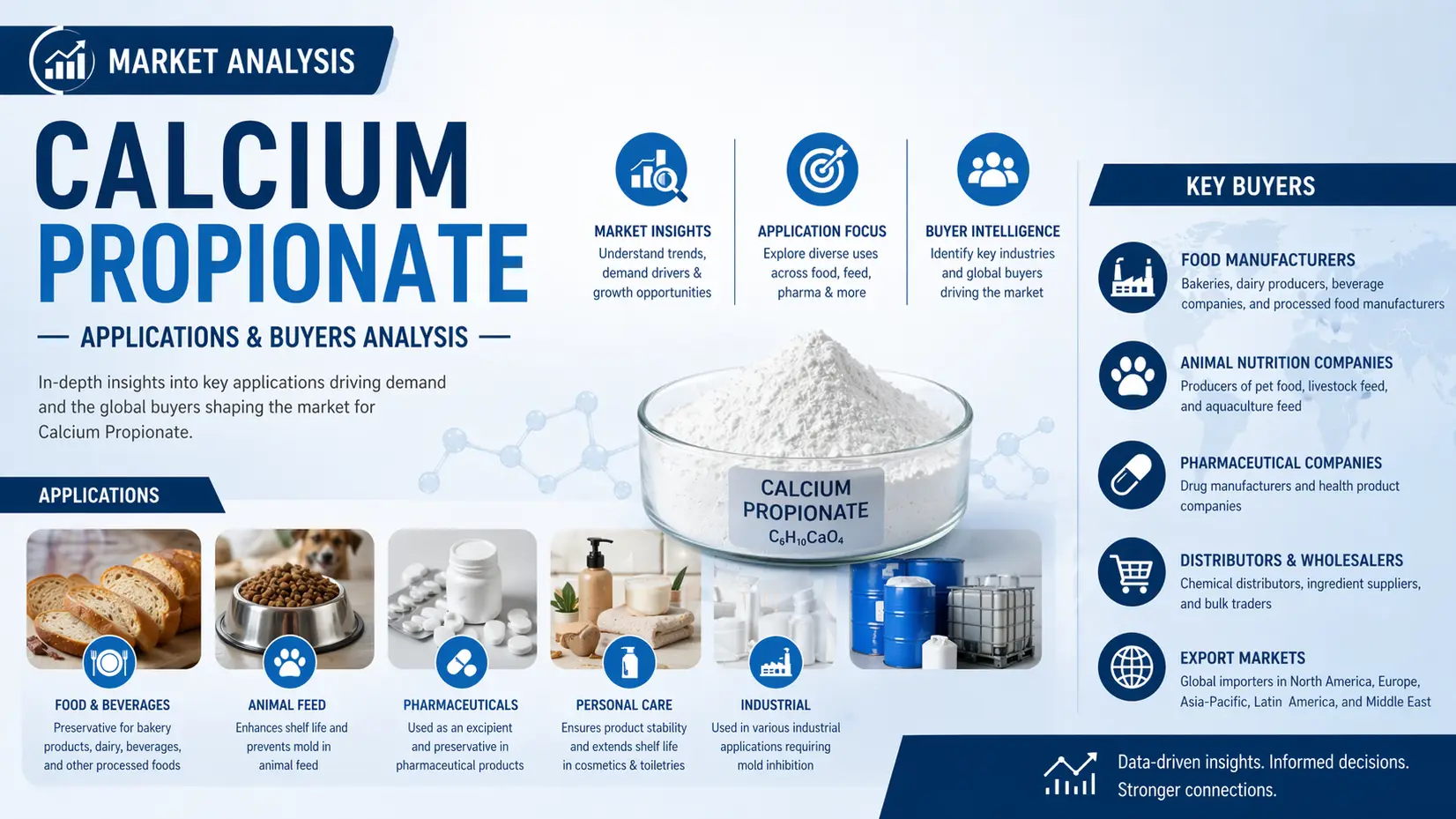
Bakery manufacturers remain the largest consumers of calcium propionate, leveraging its antifungal properties to extend shelf life in bread, cakes, and tortillas. In 2026, bakery applications account for nearly 45% of global consumption, supported by rising urbanization and packaged food demand. buyers prioritize purity grades compliance, particularly in North America. This segment alone contributes to demand growth exceeding 5.5% CAGR, reinforcing calcium propionate’s role as a staple preservative in modern food systems.
Animal Feed and Dairy Preservation Markets
In the animal nutrition sector, calcium propionate is increasingly used as a mold inhibitor in feed formulations, particularly for cattle and poultry industries. Feed manufacturers in Asia-Pacific and Latin America are expanding procurement demand from rising meat consumption. Global feed-grade demand is estimated at over 120,000 MT, representing nearly 38% of total market consumption. Price sensitivity remains high, yet stable supply chains ensure predictable procurement costs within USD 2,200–2,600/MT.
Pharmaceutical and Personal Care Utilization Expansion
Beyond food and feed, calcium propionate is gaining traction in pharmaceutical and personal care formulations as a stabilizing and antimicrobial agent. Demand is particularly strong in topical formulations and specialty drug coatings. Although this segment represents a smaller share, it is growing at a notable 4.8% CAGR, supported by regulatory acceptance and clean-label ingredient trends. High-purity grades command premium pricing, often exceeding USD 3,000/MT in specialty applications.
Regional Supply Chain and Procurement Dynamics
Asia-Pacific continues to dominate global production of calcium propionate, led by China’s large-scale chemical manufacturing base, while North America and Europe remain key import-dependent consumption hubs. Supply chain optimization and raw material integration have improved cost efficiency, supporting global trade stability. Export-oriented producers benefit from integrated propionic acid supply chains, ensuring consistent output aligned with global demand of approximately 320,000 MT annually.
Conclusion
Calcium propionate solidifies its position as a platform chemical essential to food preservation, feed stability, and specialty formulations. With sustained demand growth and expanding industrial applications, the market outlook remains positive through 2026 and beyond. As buyers prioritize reliable sourcing, integrated suppliers become critical partners in supply chain resilience. In this context, Tradeasia International offers a seamless procurement gateway for industrial-grade calcium propionate, connecting manufacturers and buyers with quality assurance and logistical efficiency.
Sources
-
https://www.fao.org/documents/card/en/c/12f0b2c8-4c5f-4f4f-a9a4-0c0f1b8d1b7b
-
https://www.fao.org/docrep/pdf/012/i1142e/i1142e04.pdf
-
https://www.feedingredientsasia.com/en/market-insights/supply-chain/calcium-propionate-market-feedstock-supply-chain-analysis
Leave a Comment