Introduction
Broken rice, a byproduct of rice milling, has emerged as a traded agri-feedstock in 2026 global markets. Output is estimated at 45 million MT, driven by Asian milling hubs. Used in feed, ethanol, and food processing, it trades between 220–340 USD/MT. Supply dynamics remain closely tied to harvest cycles and milling efficiency, while the market records a projected CAGR of 4.2%, reflecting steady industrial and feed demand integration.
Supply Origins and Milling Byproduct Flows
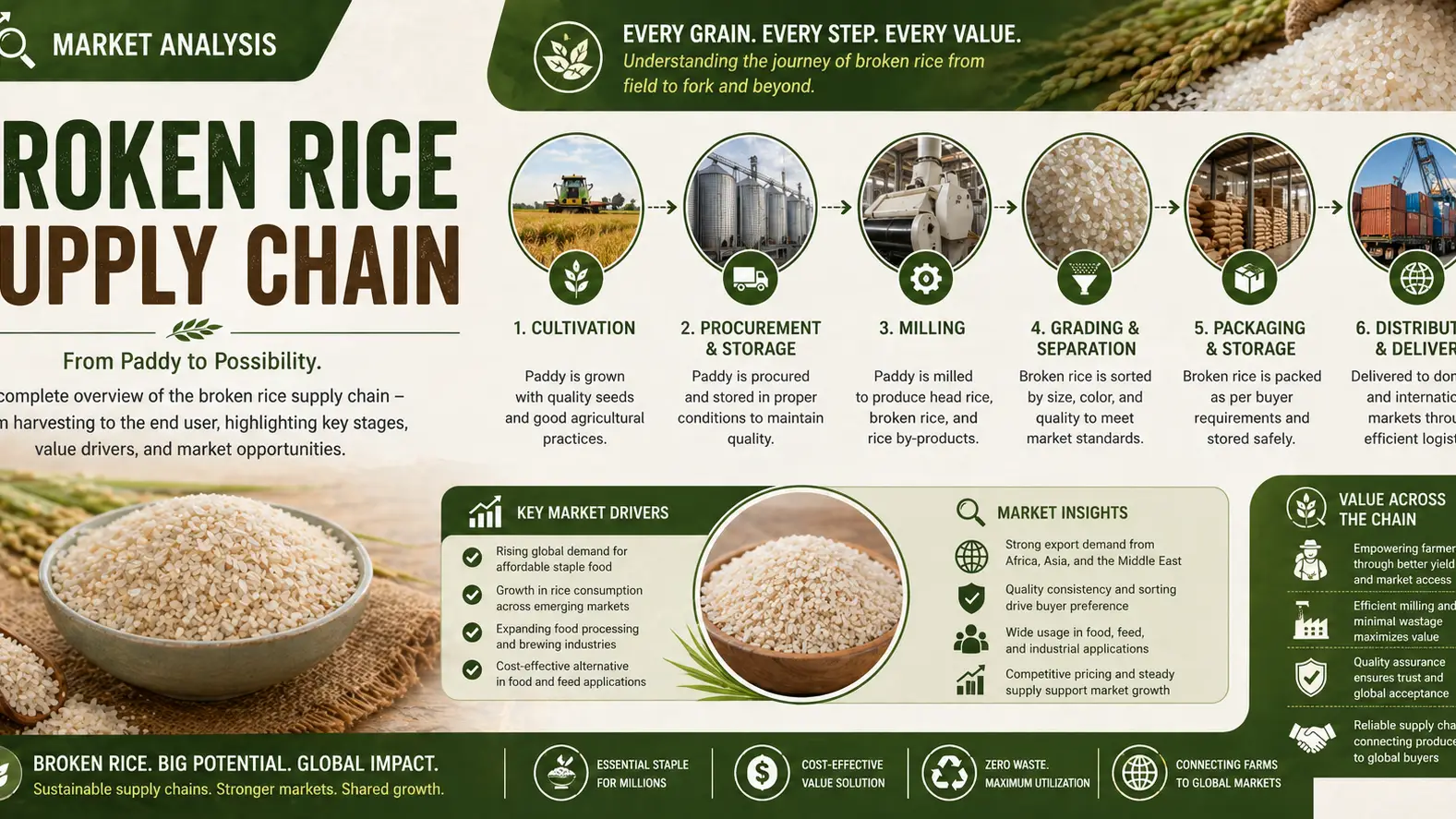
Broken rice originates from major milling nations including India, Vietnam, Thailand, and China. Milling processes yield 5–12% broken kernels, with India supplying over 18 million MT annually. Aggregation at mill level determines grading and export readiness, while seasonal harvests create intermittent supply tightening. These structural flows define baseline availability across global feed and industrial markets.
Trade and Logistics Corridors
Trade flows move from Southeast Asia to Africa and the Middle East via containerized shipping. Vietnam and Thailand dominate export routing. Freight increases of 8–12% in 2026 have lifted landed costs, while transit times average 20–35 days. Export policy shifts periodically affect availability, reinforcing volatility in import-dependent regions.
Price Formation and Volatility
Prices are influenced by feed demand, grain substitution, and logistics. In 2026, broken rice ranges 220–340 USD/MT FOB Asia. West African importers pay premiums up to 15% due to freight and currency pressures. Limited financial derivatives keep pricing largely spot-driven and sensitive to harvest cycles and policy changes.
Demand Sectors and Downstream Utilization
Feed accounts for ~60% of usage, with strong uptake in poultry and aquaculture. Ethanol and brewing industries also absorb volumes. Southeast Asia and Africa consume over 70% of traded supply. Substitution with corn and wheat drives demand shifts when global grain prices rise.
Conclusion
Broken rice supply chains in 2026 reflect their evolution into integrated agri-industrial networks supporting feed and bio-based applications. As volumes reach 45 million MT, market resilience depends on efficient logistics, storage, and cross-border coordination. Positioned as a versatile platform feedstock in agri-industrial value chains, it continues to benefit from diversified demand and regional trade flows. In this context, Tradeasia International provides end-to-end sourcing and distribution support, enabling buyers and suppliers to manage volatility and secure consistent supply across global markets.
Sources
Leave a Comment