Broken Rice: Product Definition and Supply Position
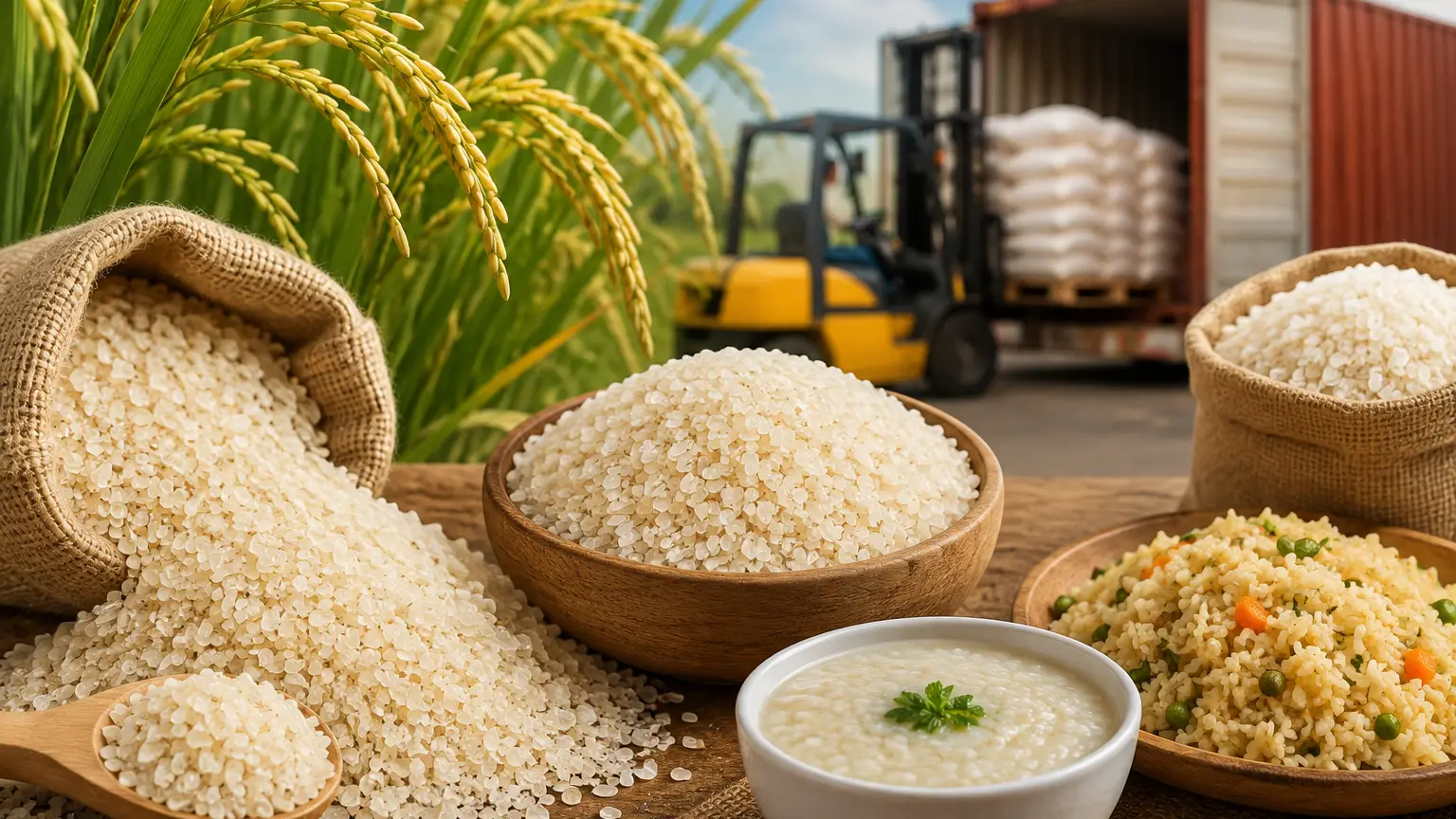
Broken rice is a commercially important rice-milling fraction rather than simply a processing residue. The supplied product page describes it as fragments of rice grain obtained during milling and separated after polishing, with the material having the same basic chemical composition as white rice. The listed product is sourced from India and is described as a white-to-off-white solid categorized under by-products and energy sources.
How broken rice is produced
The formation of broken rice is closely linked to rice milling and polishing. According to the supplied product information, polished rice is produced after removing husks, polishings, and bran from paddy rice, while broken kernels are separated during the subsequent processing stages. The product page indicates that the polishing process can yield a broken fraction, making availability structurally connected to the volume of rice being processed.
From a commercial perspective, this production route gives broken rice an important supply characteristic: it is generated as part of a much larger rice-processing ecosystem. That makes procurement different from sourcing a specialty manufactured ingredient because availability can be influenced by rice production, milling activity, grain quality, processing efficiency, and regional trade flows. Buyers therefore need to evaluate both product specifications and the reliability of the upstream milling supply chain.
Codex provides an internationally recognized framework for describing rice quality and differentiating whole kernels from large, medium, and small broken kernels. This classification is commercially relevant because the degree and proportion of breakage can affect how a material is specified and ultimately selected for a particular end use.
For B2B buyers, the practical implication is that “broken rice” should be treated as a specification-driven commodity. Procurement teams should establish the required broken percentage, particle characteristics, moisture expectations, purity, intended application, packaging, origin, and shipment requirements before comparing offers. This turns a broad commodity inquiry into a technically defined purchasing requirement and helps suppliers provide more accurate commercial proposals.
Industrial Applications Driving Broken Rice Demand
Broken rice has a broad application profile because its value is primarily associated with its starch and carbohydrate content rather than the visual integrity of the grain. The supplied product page specifically highlights animal feed and describes starch and crude protein content as relevant nutritional characteristics. FAO technical material also identifies broken rice as a raw material used in poultry feed and other animal nutrition systems.
Animal feed applications
Animal feed is one of the most commercially established outlets for broken rice. Feed manufacturers can incorporate it into formulations where a digestible cereal-based energy source is required, while the smaller grain size can also make it suitable for processing into compound feed. FAO sources identify broken rice among cereal and grain raw materials used in poultry feed and document its use in traditional and compound fish-feed formulations.
Food processing represents another important application pathway. Broken rice can be milled into rice flour and used as a raw material in processed foods, while research published in 2024 demonstrates continued development of broken-rice flour for bakery applications and improved processing characteristics. This indicates that value-added processing can expand the commercial role of broken rice beyond conventional grain and feed markets.
Starch and fermentation-related processing provides an additional industrial route. FAO technical literature describes the production of rice starch from broken rice through wet milling and also documents the conversion of broken rice into rice-derived syrups and maltodextrin. These pathways illustrate why buyers in food ingredients and starch-processing industries may evaluate broken rice according to its conversion potential rather than grain appearance alone.
Global Market Demand and Trade Trends
The market for broken rice is increasingly influenced by the interaction between food demand, animal-feed economics, industrial processing, and international grain trade. USDA Economic Research Service reported in 2025 that broken rice trade has expanded substantially over the long term and that demand from animal feed and industrial applications can influence international markets and importing countries that depend on broken rice for food.
Feed and industrial demand
USDA data show that global broken-rice trade increased from less than 1 million metric tons annually in the early 1990s to more than 10 million metric tons in 2022. The same analysis highlights strong growth in imports by China, Europe, and West Africa, demonstrating that broken rice has become an internationally traded commodity with demand extending well beyond traditional rice-consuming markets.
Market conditions remain sensitive to grain prices and trade policy. USDA's 2025 analysis notes that China's increased broken-rice imports during 2019–2022 coincided with higher domestic feed-grain prices, while later trade developments were affected by price movements and India's 2022 export restriction on broken rice. This demonstrates why buyers should not evaluate the broken rice market solely through historical demand; feed-grain substitution, government policy, crop conditions, and export availability can materially change sourcing economics.
Recent global rice-market data reinforce the importance of monitoring origin and pricing conditions. USDA's March 2026 Grain: World Markets and Trade report showed changes in global rice trade and export quotations across major origins, while also noting shifts in import and export forecasts for several rice-producing and consuming countries. For procurement teams, this supports a market-monitoring approach in which broken rice sourcing is evaluated alongside broader rice and competing-grain conditions.
Buyer Intent and Procurement Requirements
The core buyer intent behind a broken rice search is usually commercial rather than informational. Feed manufacturers, food processors, ingredient blenders, starch processors, traders, distributors, and other industrial users are typically looking to identify a suitable grade, confirm availability, compare supplier offers, and determine whether the material can meet their production and logistics requirements. USDA's research confirms that broken rice serves direct food, feed, and industrial markets, making buyer requirements highly dependent on end use.
Who buys broken rice
Animal-feed manufacturers are a major buyer group because broken rice can function as a cereal-based energy ingredient. Food manufacturers may purchase it for milling, flour production, processed foods, or other rice-derived ingredients, while industrial processors may evaluate it as a starch-containing feedstock. Traders and distributors have a different procurement objective: they need commercially tradable material with specifications, origins, shipment economics, and documentation suitable for their downstream customers.
Procurement teams typically compare suppliers on more than headline price. The relevant evaluation criteria can include broken-kernel specification, moisture, foreign matter, cleanliness, consistency between lots, origin, packaging, minimum order quantity, delivery terms, documentation, and the supplier's ability to maintain continuity of supply. Codex's rice standard demonstrates why kernel classification and buyer-specified quality factors matter when defining commercial requirements.
The reason buyers compare multiple suppliers is that the lowest quoted unit price does not necessarily represent the lowest delivered production cost. Differences in grade, quality consistency, freight, lead time, inspection, documentation, and shipment reliability can affect the actual economics of a procurement program. A supplier that can align product specifications with the buyer's application can therefore create more value than a supplier competing only on the initial quotation.
For buyers evaluating this material, the Broken Rice product page provides a direct starting point for reviewing the listed product characteristics and initiating a commercial inquiry. The page identifies India as the origin and provides basic product information, while detailed pricing, customization, and shipping information can be requested through the inquiry process.
Broken Rice Sourcing and Supplier Evaluation
A robust broken rice sourcing strategy begins with application-specific specifications. A feed manufacturer may prioritize nutritional and formulation characteristics, while a food processor may focus more heavily on milling behavior, flour performance, cleanliness, and consistency. Because broken rice can serve different end uses, buyers should communicate the intended application before asking suppliers for quotations.
Defining the purchasing specification
Quality definition should be sufficiently precise to make supplier comparisons meaningful. Buyers can specify the required broken-rice grade or percentage, particle characteristics, moisture limits, foreign-matter requirements, purity expectations, packaging format, origin preference, and acceptable tolerances. Codex's classification of large, medium, and small broken kernels provides a useful technical reference for understanding how broken fractions can be differentiated.
The next consideration is supply continuity. A supplier may offer an attractive spot price but be less suitable for a manufacturer requiring repeated monthly shipments. Procurement teams should therefore evaluate available volumes, production origin, shipment frequency, logistics capability, lead times, documentation, and the supplier's ability to manage changes in market availability. This is particularly important because USDA research demonstrates that broken rice trade responds to feed-grain prices, export policies, and regional demand shifts.
Commercial due diligence should also connect technical requirements with landed cost. Freight, port handling, packaging, inspection, insurance, duties, and payment terms can materially influence the final procurement economics. For international buyers, a structured request for quotation that defines specifications and delivery requirements before price comparison can reduce ambiguity and make competing supplier proposals easier to assess.
Supply Chain and Commercial Positioning
Broken rice has commercial importance because it connects rice milling with several downstream value chains. Instead of being evaluated only as a secondary grain fraction, it can be positioned according to its role in feed, food processing, flour, starch, and other industrial applications. USDA's recent analysis supports this broader view, identifying broken rice as a product traded for direct consumption, animal feed, and industrial use.
Supporting B2B procurement
For manufacturers and distributors, reliable sourcing can reduce the operational risk associated with fluctuating raw-material availability. A B2B marketplace or integrated supply-chain partner can help buyers move from general product discovery toward a structured procurement process by connecting application requirements with product specifications, origin, logistics, and commercial inquiry.
The positioning of Tradeasia is relevant to this model because the company describes itself as a global B2B raw-material supply-chain partner with capabilities spanning sourcing, quality, and supply-chain coordination. Its Singapore headquarters and international network provide a logical platform for serving cross-border procurement requirements.
For Chemtradeasia and the emerging Tradechem Marketplace model, the broader opportunity is to make sourcing more structured and transparent for industrial buyers. Tradechem describes its marketplace concept around connecting buyers with suppliers, structured RFQs, shipment tracking, and sourcing management, which aligns with the information requirements of commodity procurement even when buyers need to compare multiple commercial variables.
Conclusion: Building a Reliable Broken Rice Supply Strategy
Broken rice is a commercially versatile milling fraction with established relevance in animal feed and growing opportunities across food and industrial processing. Its value is derived from the combination of rice-derived starch and nutrients, application flexibility, and its relationship with the larger rice-processing supply chain. The supplied product listing identifies India as the origin and specifically positions the material as an animal-feed and energy-source product.
From product search to procurement decision
For procurement teams, the most important step is to connect the product specification with the intended application. Feed buyers, food processors, starch users, traders, and distributors may require different quality parameters and commercial structures. A clear specification therefore provides the foundation for comparing suppliers, negotiating efficiently, and avoiding unsuitable offers.
The global outlook also favors a data-led procurement approach. USDA research shows that broken rice trade has expanded substantially and that demand can shift in response to animal-feed economics, food requirements, international prices, and trade policy. At the same time, recent food-science research demonstrates continued exploration of higher-value applications for broken rice flour, indicating that downstream processing can create additional demand channels.
For businesses evaluating bulk broken rice sourcing, the Broken Rice sourcing and product information page offers a direct commercial entry point for reviewing the listed material and submitting an inquiry. In a market where application requirements and international supply conditions can change, combining product-level specifications with supplier capability, logistics planning, and market intelligence can help procurement teams build a more resilient sourcing strategy.
Sources
Leave a Comment