Broken Rice Market Demand and Commercial Relevance
From Milling By-Product to Commercial Ingredient
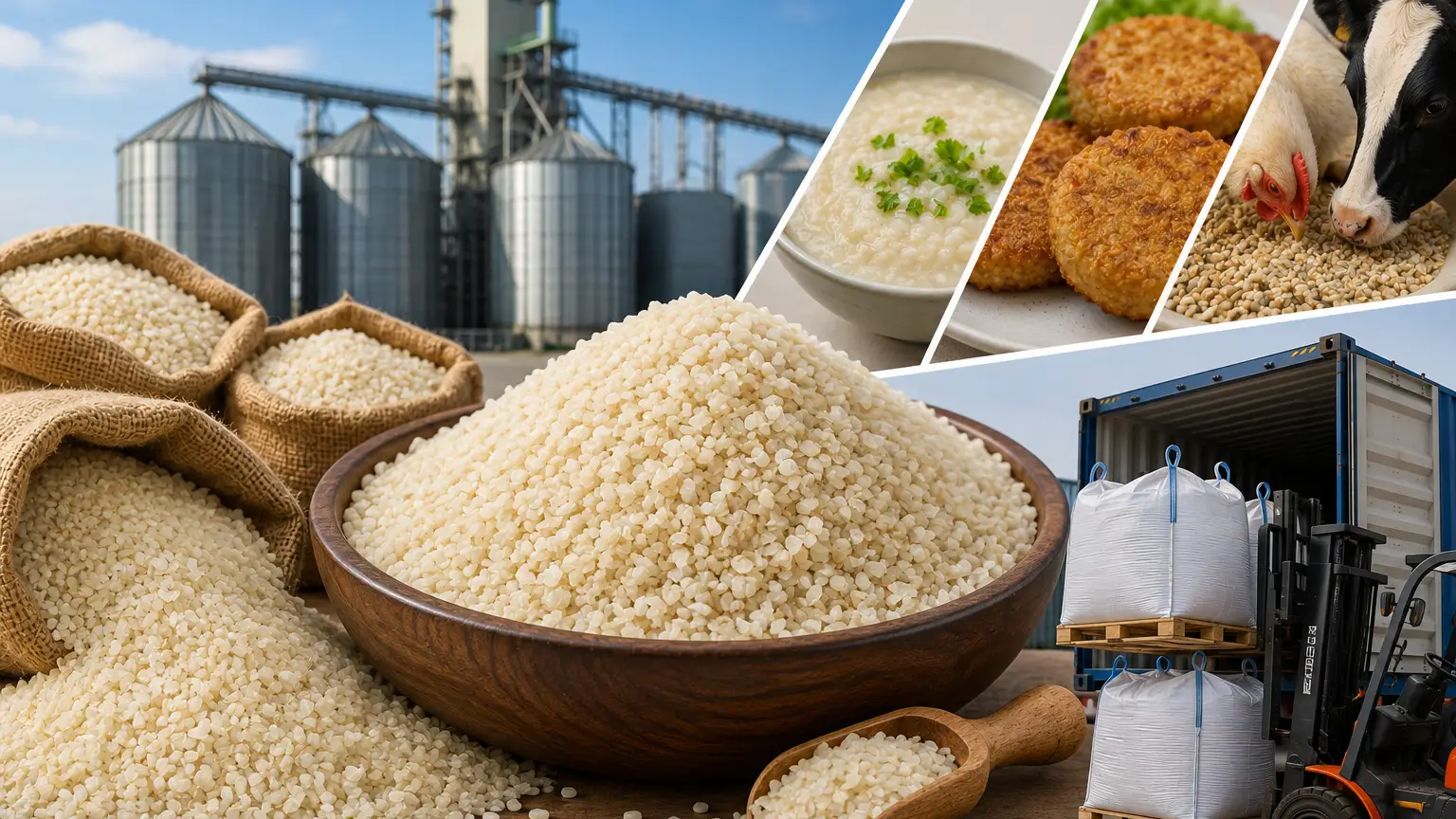
Broken rice is produced when rice grains fracture during milling. Although the fragments have lower visual value than whole kernels, their underlying nutritional and functional characteristics make them commercially useful for food, feed, and industrial processing. This distinction is increasingly important for B2B procurement teams because purchasing decisions are often driven by application performance and economics rather than appearance alone. The U.S. Department of Agriculture's Economic Research Service reported in 2025 that broken rice is sold for direct consumption, animal feed, and industrial uses, highlighting its broad commercial role.
Why Demand Matters to Buyers
The commercial importance of broken rice is also connected to the scale of international trade. USDA analysis reported that global broken rice trade increased from less than 1 million metric tons annually in the early 1990s to more than 10 million metric tons in 2022. The same analysis identifies animal feed, industrial applications, consumer-product blending, and direct food consumption as important demand channels.
For manufacturers and traders, this creates a sourcing category where price competitiveness can coexist with application-specific requirements. Buyers may seek broken rice because it can provide a practical rice-derived carbohydrate input without requiring the visual specifications associated with premium whole-grain rice. Consequently, the commercial opportunity depends on matching the right material specification with the right processing route and end-use requirement.
For procurement professionals, the market should therefore be evaluated through an application lens rather than as a simple commodity purchase. Feed manufacturers, food processors, ingredient producers, starch processors, and fermentation businesses can have different expectations regarding particle characteristics, cleanliness, moisture, consistency, packaging, documentation, and supply continuity. A B2B marketplace can help connect these requirements with suitable supplier information.
Major Industrial Applications of Broken Rice
Animal Feed and Feed Formulation
One of the established uses of broken rice is as a carbohydrate-rich ingredient in animal feed formulations. Its economic positioning can make it relevant when feed manufacturers compare cereal-based energy sources and formulate diets around nutritional specifications, availability, and cost. Recent scientific research continues to examine broken rice directly in poultry nutrition, including the relationship between broken-rice inclusion, starch digestion, and feed efficiency.
Starch and Ingredient Manufacturing
Broken rice can also serve as a raw material for producing rice-derived ingredients. Scientific literature describes its use in rice flour production and as a source of starch for food and industrial applications. Rice starch can provide functional characteristics relevant to thickening, stabilization, gelling, and water management, creating opportunities beyond the traditional feed market.
The breadth of these applications makes broken rice relevant to several types of industrial buyers. A feed mill may prioritize nutritional consistency and cost, while a food ingredient processor may place greater emphasis on milling characteristics and functional performance. A starch or fermentation producer may instead assess the raw material according to starch yield, process compatibility, and production economics.
This diversity also explains why broken rice applications are an important commercial search category. Buyers researching broken rice uses are often not looking only for a commodity description; they are trying to determine whether a particular material can fit a production process. Supplier information that connects the product with its potential industrial applications can therefore shorten the path from product discovery to qualified sourcing.
Food Processing and Value-Added Opportunities
Rice Flour and Processed Foods
Food processing represents an important route for increasing the value of broken rice. Research has documented the conversion of broken rice into rice flour and its use in processed food systems, while more recent research has investigated ways to transform broken rice into functional and reconstituted food products.
For food manufacturers, the attraction is not necessarily the broken appearance of the raw material but the ability to process it into an ingredient that can be incorporated into other formulations. Milling, extrusion, thermal treatment, fermentation, and other processing technologies can change the functional characteristics of the material and open opportunities for food ingredient development.
Functional Ingredient Development
Scientific research also indicates growing interest in value-added utilization of rice milling co-products. USDA Agricultural Research Service research initiated in 2025 specifically includes utilization of rice by-products, including broken rice, to develop higher-value foods and ingredients. This reflects a broader industry movement toward improving resource efficiency and extracting greater commercial value from agricultural processing streams.
For B2B buyers, this trend can translate into demand from manufacturers developing rice flour, extruded products, fermented ingredients, starch-based materials, and other rice-derived formulations. The relevant sourcing question is therefore not simply whether broken rice is available, but whether its specification, consistency, and supply format align with the intended processing technology.
Animal Feed Applications and Buyer Demand
Feed Manufacturers as Core Buyers
Animal feed remains one of the most commercially relevant applications for broken rice. Its use as a cereal-derived energy ingredient places it within procurement decisions involving poultry, livestock, aquaculture, and other feed categories. USDA research identifies feed as one of the major destinations for broken rice and notes that increasing feed and industrial demand can influence international trade flows.
Nutritional and Processing Considerations
Feed buyers need to assess more than nominal price when evaluating broken rice. Nutritional composition, starch availability, moisture, cleanliness, particle characteristics, storage stability, and compatibility with feed manufacturing processes can all influence the practical value of a shipment. Recent poultry research demonstrates continued scientific attention to the digestion kinetics of starch supplied through broken rice, reinforcing the importance of considering performance rather than commodity price alone.
The commercial relevance extends to aquaculture and other formulated-feed markets where carbohydrate sources can influence extrusion and pellet characteristics. Recent research comparing broken rice flour with other carbohydrate sources in extruded aquaculture feed illustrates how rice-derived ingredients can be evaluated not only nutritionally but also according to their processing behavior.
Consequently, feed manufacturers searching for a broken rice supplier may compare suppliers on several dimensions at once. Reliable documentation, consistent specifications, appropriate packaging, shipment reliability, and responsiveness can become as important as the quoted price, particularly for manufacturers operating continuous production lines or serving customers with defined formulation specifications.
Broken Rice Buyers and Procurement Priorities
Who Buys Broken Rice?
The buyer base can include animal feed manufacturers, food processors, rice flour producers, starch manufacturers, fermentation businesses, ingredient traders, distributors, and industrial procurement teams. Direct food markets can also be relevant in regions where broken rice is incorporated into traditional foods. USDA's international trade analysis confirms that broken rice serves both food and non-food markets, making buyer segmentation particularly important when evaluating commercial opportunities.
What Procurement Teams Evaluate
Before purchasing, procurement teams typically need to understand the intended application and then translate that requirement into a material specification. Depending on the end use, relevant considerations can include grain size or particle profile, moisture, cleanliness, foreign-material control, microbiological requirements, packaging format, documentation, origin, available volume, and delivery terms.
Supplier comparison is especially important because a lower quoted price does not necessarily represent the lowest total procurement cost. Differences in consistency, logistics, documentation, minimum order quantities, lead times, and application suitability can affect the effective cost of using the raw material in production.
For buyers evaluating broken rice sourcing, the product information stage is therefore commercially significant. A clear sourcing page can help procurement teams understand what is being offered before they request quotations or technical information. Buyers evaluating this category can consult the Broken Rice product page for product and sourcing information relevant to their purchasing assessment.
Global Market and Supply Considerations
International Trade Trends
Broken rice has become an increasingly visible component of international rice trade. USDA analysis published in 2025 found that global broken rice trade had grown substantially over the long term, with China, Europe, West Africa, and other importing regions contributing to international demand. This supports the view that broken rice should be considered within broader global commodity and feed-ingredient sourcing strategies.
Rice Supply Outlook
The broader rice market also provides important context. FAO's latest cereal supply and demand assessment forecasts global rice utilization at 558.2 million tonnes in 2026/27, representing a 0.9% increase and a new peak, while global rice production is forecast at approximately 552.5 million tonnes on a milled basis. These figures indicate continued structural demand for rice even as annual production and trade conditions fluctuate.
At the same time, international sourcing cannot be separated from weather, logistics, energy costs, trade policy, and geopolitical conditions. FAO's 2026 Food Outlook highlights weather developments, energy and fertilizer-market volatility, geopolitical tensions, and trade-policy uncertainty as factors that can affect global food commodity markets. For broken rice buyers, these factors can influence availability, freight economics, lead times, and supplier competitiveness.
The practical implication is that buyers should avoid treating broken rice market outlook as a single price forecast. A more useful commercial assessment considers demand by application, availability from producing regions, import requirements, freight conditions, alternative feed ingredients, and the ability of suppliers to provide consistent volumes. This broader approach is particularly relevant for distributors and manufacturers planning recurring procurement.
B2B Sourcing Strategy and Commercial Positioning
Matching Applications With Suppliers
Effective B2B broken rice procurement begins by defining the application before comparing offers. Feed manufacturers may prioritize nutritional and processing specifications, while food and ingredient manufacturers may require characteristics suited to milling, extrusion, starch extraction, or other processes. The supplier selection process should therefore connect technical requirements with commercial terms rather than evaluating price in isolation.
Why Reliable Sourcing Matters
Supply reliability can directly affect production continuity. Manufacturers that use broken rice as a recurring input need confidence in specifications, availability, communication, documentation, and logistics. For traders and distributors, reliable sourcing is similarly important because their commercial value depends on supplying downstream customers with material that meets agreed requirements.
A B2B marketplace positioning can support this process by bringing product discovery, supplier information, application context, and buyer inquiries closer together. For Tradeasia, Chemtradeasia, and Tradechem Marketplace, the commercial opportunity lies in helping industrial buyers move from a broad search such as buy broken rice B2B toward a more qualified sourcing conversation based on application and procurement needs.
The Broken Rice supplier information can serve as a starting point for buyers assessing availability and potential industrial applications. For manufacturers, traders, distributors, and procurement teams, this type of product-specific entry point can help turn market research into a practical supplier evaluation process.
Conclusion: Turning Broken Rice Demand into Sourcing Opportunities
From Commodity to Application-Driven Opportunity
Broken rice demonstrates how a milling fraction can become a commercially relevant raw material when evaluated according to application rather than appearance. Its established role in animal feed, combined with applications in food processing, flour, starch, fermentation, and other value-added areas, gives it relevance across several B2B industries. USDA and scientific research both point to expanding utilization and continued interest in higher-value applications.
The Buyer Opportunity
For buyers, the central opportunity is to identify where broken rice provides the best combination of technical suitability, supply reliability, and cost efficiency. Feed manufacturers, food processors, ingredient producers, traders, and distributors may all approach the product differently, but each requires credible information before committing to a supplier.
The Supplier Opportunity
For suppliers and distributors, demand is increasingly application-driven. Communicating suitable uses, available specifications, commercial quantities, documentation, and sourcing capabilities can make a product listing more useful to professional buyers and improve the quality of inbound inquiries.
A Practical B2B Sourcing Path
As global rice utilization remains substantial and broken rice continues to participate in food, feed, and industrial trade flows, the category offers a practical opportunity for manufacturers and procurement teams seeking rice-derived raw materials. Buyers can use the Broken Rice product page for industrial applications as a starting point for evaluating sourcing information and moving toward supplier discussions.
Sources
Leave a Comment