Understanding Blood Meal and Its Commercial Role
What Blood Meal Is
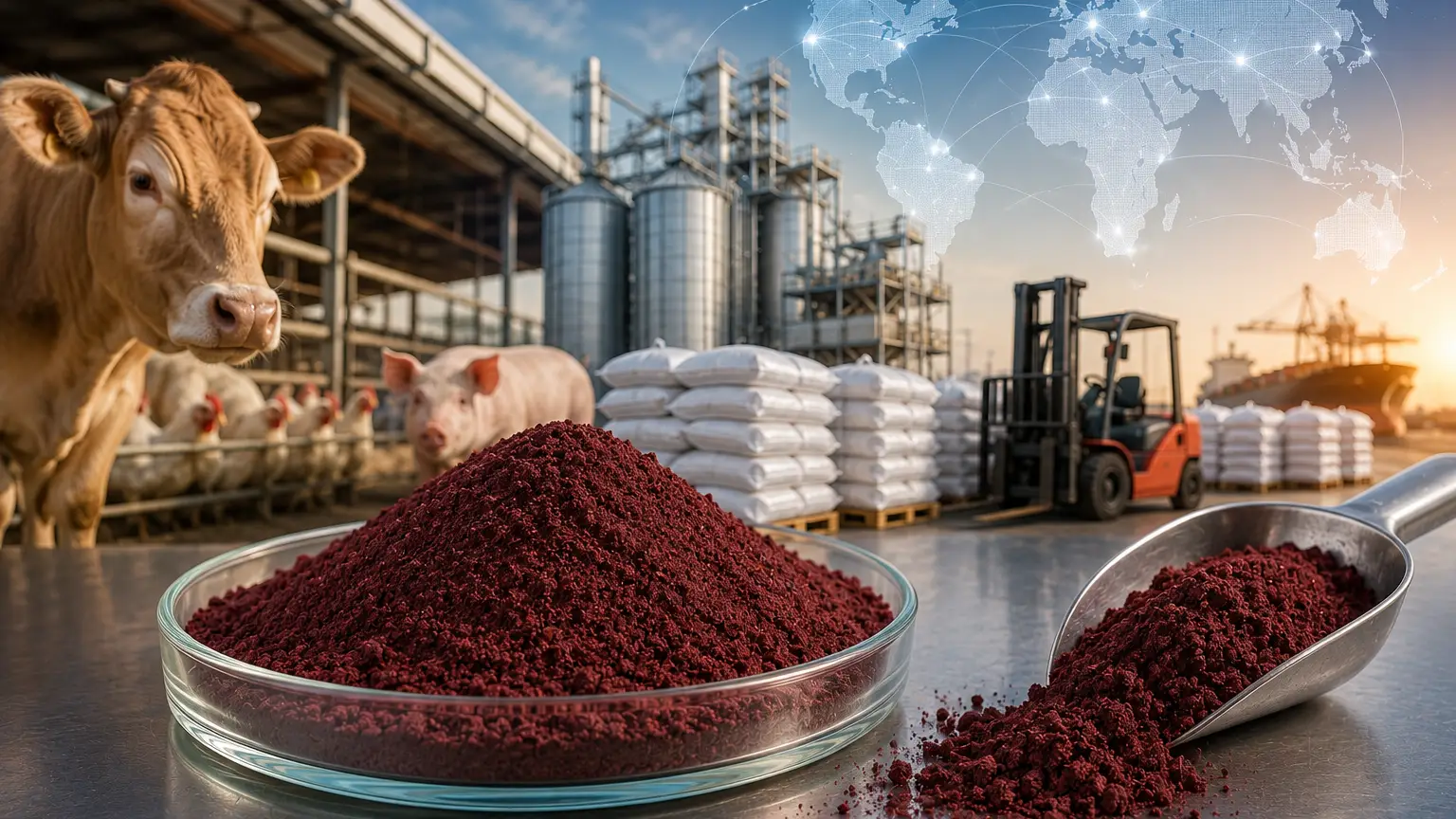
Blood Meal is a dried animal-derived protein material produced from blood collected during slaughter processing. The Food and Agriculture Organization's AGROVOC database defines blood meal as a dry powder made from blood, generally sourced from cattle or hogs. The Tradeasia product specification describes the material as a dark red to brown powder, with less than 10% moisture and a minimum crude protein content of 80%. These characteristics make Blood Meal commercially relevant where concentrated protein and consistent dry-material handling are required. FAO AGROVOC
Processing and Product Characteristics
Commercial Blood Meal is produced by collecting animal blood and processing it through drying, with the objective of reducing moisture and producing a stable material suitable for handling and storage. The Tradeasia product page identifies spray-dried Blood Meal with bovine/porcine origin, approximately 0.50 g/cm³ bulk density, minimum 80% pepsin digestibility, minimum 7% lysine, and maximum 1% crude fat. These parameters are important to buyers because they influence formulation, storage, transportation, and the suitability of the material for particular applications.
From a commercial perspective, Blood Meal is best understood as a processed animal by-product rather than simply a commodity powder. The European Commission notes that animal by-products such as blood can have significant nutritional value but require appropriate processing because untreated materials can present animal and public-health risks. This creates a direct connection between product value and the quality of the processing, traceability, and intended end use. European Commission — Animal By-Products
For B2B buyers, this means sourcing decisions should begin with the intended application rather than price alone. Feed manufacturers, agricultural input companies, distributors, and procurement teams may require different specifications and documentation depending on destination market and end use. A clear understanding of origin, processing category, analytical specifications, microbiological controls, packaging, and regulatory status can therefore reduce qualification risk and make supplier comparison more meaningful.
Key Industrial Applications and End-Use Demand
Animal Feed Applications
One of the principal commercial applications for Blood Meal is as a concentrated animal-feed protein ingredient. The Tradeasia specification classifies the product as feed grade and reports minimum crude protein of 80%, minimum lysine of 7%, and minimum pepsin digestibility of 80%. These characteristics make Blood Meal relevant to compound-feed manufacturers and other buyers evaluating concentrated animal protein sources for formulation purposes.
Feed applications, however, are highly dependent on species, formulation requirements, source material, and applicable regulations. Scientific research has examined Blood Meal as a protein ingredient in pig diets, demonstrating that inclusion level can affect intake and growth performance rather than producing a simple linear benefit at higher usage rates. For procurement teams, this reinforces the importance of working from formulation requirements and technical specifications instead of treating Blood Meal as an interchangeable protein commodity. Animal Feed Science and Technology study
Regulatory conditions can also determine the addressable feed market. European rules, for example, impose specific conditions on processed animal proteins and blood products, including requirements concerning source animals, processing establishments, segregation, storage, labeling, and permitted animal species. Consequently, a Blood Meal supplier may need to demonstrate much more than a certificate of analysis when selling into regulated feed markets. EUR-Lex — Animal Feeding Rules
Blood Meal also has an established agricultural use as a nitrogen-rich organic fertilizer. Colorado State University Extension describes Blood Meal as one of the highest non-synthetic nitrogen sources among organic fertilizer materials, while cautioning that excessive application can cause plant injury. This gives the product a second important commercial pathway and broadens the potential buyer base beyond feed manufacturers to fertilizer blenders, agricultural distributors, horticultural suppliers, and other agricultural-input businesses. Colorado State University Extension — Organic Fertilizers
Blood Meal Buyer Groups and Procurement Intent
Who Buys Blood Meal
The primary B2B buyer groups include animal-feed manufacturers, livestock nutrition businesses, agricultural-input companies, fertilizer producers, distributors, importers, and specialty trading companies. Feed buyers generally focus on protein, amino-acid profile, digestibility, microbiological specifications, species of origin, and regulatory suitability, while fertilizer buyers are more likely to emphasize nitrogen content, consistency, handling characteristics, and agricultural-market requirements. The Tradeasia product specification provides a useful example of the type of technical information that can support this initial qualification process.
Procurement intent can range from spot purchasing and distributor replenishment to long-term supply contracts and manufacturer qualification. A buyer searching for a "Blood Meal supplier" is usually closer to a commercial transaction than a user searching simply for "what is Blood Meal." The former may already know the application and need information on origin, specification, packaging, documentation, lead time, and commercial availability before requesting a quotation or sample.
What Procurement Teams Evaluate
Procurement teams typically compare suppliers across several dimensions, including product specification, consistency between batches, source and species declaration, processing method, microbiological controls, certifications, regulatory documentation, packaging format, storage requirements, logistics capability, and commercial terms. For the Tradeasia product, available information includes 50 kg PP woven-bag packaging, 12-month shelf life, cool and dry storage conditions, ISO/HACCP status, available Halal certification on request, and declared compliance parameters for heavy metals and dioxins/PCBs.
Supplier comparison is particularly important for animal-derived materials because regulatory requirements can vary substantially by country and application. The European Commission describes traceability, safe sourcing, treatment, transportation, and risk-based controls as core elements of the animal-by-product framework. Buyers therefore benefit from comparing suppliers on documentation and compliance capability alongside price, since a lower quoted price may not represent a lower total procurement cost if the material fails qualification or cannot enter the destination market. European Commission — EU Animal By-Product Rules
For buyers beginning a sourcing project, the Blood Meal product page provides a practical starting point for reviewing product specifications and requesting further commercial information. Its listed technical parameters can help procurement teams establish an initial specification before discussing volume, customization, documentation, shipping, and application requirements with a supplier.
Quality, Compliance, and Supplier Evaluation
Technical Quality Parameters
Quality evaluation should begin with parameters directly connected to the buyer's application. For feed-grade Blood Meal, crude protein, crude fat, ash, calcium, phosphorus, lysine, pepsin digestibility, moisture, microbiological limits, and species of origin can all be commercially relevant. The Tradeasia specification lists minimum 80% crude protein, maximum 1% crude fat, maximum 4.5% ash, 0.30% calcium, 0.22% phosphorus, minimum 7% lysine, and minimum 80% pepsin digestibility.
Microbiological quality is another important procurement consideration. The listed Blood Meal specification includes Total Plate Count below 500,000 CFU/g, yeast and mould below 50,000 CFU/g, E. coli below 100 CFU/g, coliform bacteria below 1,000 CFU/g, and Salmonella negative in a 25 g sample. These figures illustrate why a commercial buyer should request current batch documentation and verify that the specification being quoted matches the regulatory and technical requirements of the destination market.
Regulatory and Traceability Requirements
Regulatory suitability is particularly important because Blood Meal is derived from animal material. The European Food Safety Authority explains that animal by-products are subject to controls covering handling, collection, processing, storage, and use, with risk-based categorization and rules governing permitted applications. In the European market, processed animal proteins and blood products can be subject to detailed conditions depending on source and intended animal feed use. EFSA — Animal By-Products
Import and market-entry requirements can also affect sourcing decisions outside Europe. U.S. regulations, for example, contain requirements governing the importation of Blood Meal intended for fertilizer or animal-feed use, including conditions relating to origin and processing. This illustrates why an international buyer should assess destination-country requirements before finalizing a supplier rather than assuming that a product acceptable in one market will automatically be acceptable in another. U.S. e-CFR — Blood Meal Import Requirements
Market Trends and Supply Opportunities
Circular Bioeconomy and Resource Recovery
One of the most relevant recent trends for Blood Meal is the growing focus on converting slaughterhouse by-products into higher-value resources. A 2024 review indexed by FAO AGRIS describes blood and other slaughter by-products as sources of animal protein and other valuable components, with potential applications across feed, food, medical, and technological industries. This reinforces the broader commercial movement toward resource recovery rather than treating slaughterhouse residues solely as waste streams. FAO AGRIS — Slaughter Waste Recycling Opportunities
Recent research also demonstrates the potential for integrated processing of livestock blood into different value-added products. A 2024 case study reported a large-scale process capable of converting livestock blood into amino-acid liquid fertilizer and dried protein feedstuff, highlighting how processing technology can create multiple commercial pathways from the same raw material. For Blood Meal suppliers and manufacturers, this broader circular-bioeconomy trend can support opportunities in both established and emerging end-use markets. FAO AGRIS — Livestock Blood Processing Case Study
Regulatory developments are also shaping the market. The European Commission's current animal-by-product framework recognizes that processed materials can reach defined end points and then fall under legislation appropriate to their final use, including fertilizers, animal feed, pet food, biofuels, and other applications. This regulatory structure encourages a risk-based approach in which safe processing and traceability determine whether animal-derived materials can be commercially recovered and utilized. European Commission — Animal By-Product End Points
For manufacturers, traders, and distributors, these developments create supply opportunities where reliable processing and documentation can connect recovered animal resources with established industrial demand. The opportunity is not simply to sell more volume; it is to provide consistent material that meets the buyer's application, regulatory market, and quality requirements. Suppliers able to combine dependable specifications with transparent origin information and responsive documentation are better positioned to serve procurement teams operating across international markets.
B2B Sourcing Strategy and Commercial Outlook
Building a Reliable Procurement Strategy
A practical Blood Meal sourcing strategy should start by defining the end use, target animal species or agricultural application, destination country, minimum technical specification, required certifications, packaging format, and expected purchasing volume. Buyers should then request a current technical data sheet, safety documentation where applicable, certificate of analysis, origin information, microbiological results, and relevant regulatory declarations. This structured approach allows procurement teams to compare suppliers on an equivalent basis.
For international purchasing, logistics should be evaluated alongside product quality. Moisture control, packaging integrity, storage conditions, shelf life, shipment size, port requirements, and destination-country import rules can all influence the landed cost and usability of Blood Meal. The Tradeasia product information specifies 50 kg PP woven bags, a 12-month shelf life, and cool, dry, pest-free storage, giving buyers a baseline for discussing transportation and warehouse requirements.
Commercial Positioning for B2B Buyers
The commercial relevance of Blood Meal comes from its combination of concentrated protein value, agricultural nitrogen potential, and its role in converting an animal-processing by-product into a usable industrial input. Demand is therefore influenced by feed formulation requirements, fertilizer applications, livestock-processing volumes, regulatory conditions, and the availability of qualified processed material. A 2024 scientific review similarly identifies slaughterhouse blood as a resource with potential for value-added utilization and circular-economy applications. Food and Bioproducts Processing review
For procurement teams looking to source commercially, a B2B marketplace can simplify the first stage of supplier evaluation by bringing product specifications, application information, technical documents, and inquiry channels together. Tradeasia's Blood Meal sourcing page can serve as a direct entry point for buyers assessing the product, requesting additional information, and progressing toward commercial discussions based on their required specifications and destination market.
The outlook for Blood Meal is therefore best viewed through applications and supply quality rather than through commodity pricing alone. Buyers seeking dependable supply should prioritize verified specifications, appropriate processing, traceability, regulatory fit, and supplier responsiveness, while manufacturers and distributors can focus on markets where these attributes translate into repeat procurement demand. For businesses evaluating Blood Meal suppliers, the combination of application knowledge and structured sourcing support can help turn an initial product search into a more efficient B2B purchasing decision.
Sources
Leave a Comment