Understanding Bakery Meal in the Feed Supply Chain
What Bakery Meal Is
Bakery meal is a processed feed ingredient made from dried bakery by-products. The product supplied by Tradeasia is described as a mixture of breads, chips, crackers, cookies, cereals, and other baked goods that are no longer intended for human consumption. The material is processed into a light-brown powder or crumbles and is positioned commercially as a feed-grade energy source.
From a nutritional perspective, bakery meal is primarily relevant because of its carbohydrate and fat contribution to compound feed. The Tradeasia specification indicates approximately 55–62% dry-matter starch plus sugars and 7–10% crude fat, while crude protein is specified at 10–14%. This profile makes bakery meal particularly relevant when feed formulators are assessing energy-dense ingredients alongside conventional cereal-based inputs.
The supply-chain character of bakery meal is also important. Unlike a single-origin agricultural commodity with relatively uniform composition, bakery meal can represent a mixture of processed bakery streams. Scientific literature describes bakery meal as a feed ingredient derived from surplus or unsalable bread, breakfast cereals, cookies, and related products, meaning composition can depend on the source materials entering the processing system.
For B2B buyers, this means bakery meal should be evaluated as both a feed ingredient and a managed supply-chain material. Buyers need to understand the declared composition, processing method, moisture level, microbiological specifications, packaging, storage requirements, and documentation before incorporating it into procurement programs. These factors determine whether a particular bakery meal specification fits a feed manufacturer's formulation and quality system.
Industrial Applications and End-Use Opportunities
Poultry and Swine Feed
Poultry and swine are among the most established application areas for bakery meal. Its starch, sugar, and fat contribution can make it useful as an energy-bearing component in compound feed, while the baked-product origin can contribute to palatability. Tradeasia specifically identifies poultry and pigs among the common animal-feed applications for its bakery meal product.
For poultry-feed manufacturers, bakery meal can be assessed as part of a broader energy strategy rather than as a direct one-for-one replacement for every cereal ingredient. Formulators must consider the ingredient's actual nutrient contribution, inclusion level, ash and fiber constraints, and the nutritional requirements of the target animal. The commercial value therefore depends on formulation economics as much as on the nominal price per tonne.
Swine nutrition is another important application because research has examined bakery meal and former food products as alternative feed resources. A 2023 study published in Sustainability investigated bakery meal derived from food by-products in pig diets and reported that a 20% inclusion level did not significantly affect growth performance or meat quality under the study conditions. Such findings support continued technical interest while also demonstrating that application decisions should remain formulation- and trial-specific.
The wider implication for procurement teams is that bakery meal should be sourced according to the intended feed application. A poultry integrator, swine-feed manufacturer, and general livestock-feed producer may have different requirements for nutrient consistency, physical form, microbiological limits, documentation, and delivery schedules. Application-led sourcing can therefore produce better purchasing decisions than treating bakery meal as a generic commodity.
Market Trends Shaping Bakery Meal Demand
Circular Feed Ingredients
One of the strongest structural trends supporting bakery meal is the growing interest in converting food-chain by-products into useful feed resources. The Food and Agriculture Organization has highlighted the role of circular agrifood systems and the potential of food waste and by-products to deliver environmental and socioeconomic benefits, while emphasizing that safety controls must accompany these systems.
This trend changes the commercial conversation around bakery meal. Rather than viewing bakery-derived material only as a disposal stream, manufacturers and traders can treat appropriately processed material as an input into animal nutrition. For buyers, that creates an opportunity to diversify feed-ingredient sourcing while participating in resource-efficiency strategies that connect food manufacturing with livestock production.
At the same time, circularity does not eliminate procurement risk. FAO notes that circular processes can introduce microbiological, chemical, and physical hazards if risks are not properly controlled. This is particularly relevant to bakery meal because the source material may consist of multiple bakery products and therefore requires controlled collection, separation, processing, testing, and storage.
The market outlook should consequently be viewed through two linked developments: increasing interest in alternative and circular feed ingredients, and increasing expectations for traceability and safety. Buyers are likely to place greater emphasis on documented specifications and reliable processing rather than simply seeking the lowest-cost bakery by-product available. This favors suppliers and marketplaces capable of connecting product information with practical sourcing requirements.
Buyer Intent and Procurement Decision Factors
Who Buys Bakery Meal
The primary B2B buyer groups include compound-feed manufacturers, livestock integrators, poultry-feed producers, swine-feed producers, dairy and beef feed operators, ingredient distributors, commodity traders, and procurement teams responsible for animal-nutrition inputs. These buyers generally approach bakery meal with a defined application, target volume, required specification, and landed-cost objective rather than as a consumer product.
Buyer intent typically begins with technical qualification and progresses toward commercial comparison. A procurement team searching for a bakery meal supplier may first need confirmation of feed-grade status, origin, nutrient specifications, microbiological parameters, packaging, shelf life, and available documentation. Once technical suitability is established, purchasing teams can compare price, minimum order quantities, logistics, payment terms, lead times, and supply continuity.
Supplier comparison is especially relevant because bakery meal can vary according to the mixture of bakery-derived inputs and the processing system. Tradeasia's listed specification provides concrete reference points, including less than 12% moisture, 10–14% crude protein, 7–10% crude fat, maximum 2.5% crude fiber, and maximum 4.0% ash, together with microbiological and contaminant specifications.
A dedicated Bakery Meal sourcing page can therefore serve as an important commercial entry point for buyers moving from research to supplier evaluation. Product-level information gives procurement, technical, and commercial teams a common reference before they request pricing, confirm logistics, or assess whether the material fits their feed-production requirements.
Quality, Safety, and Sourcing Specifications
What Procurement Teams Should Evaluate
Quality assessment should begin with physical and nutritional specifications. The available Tradeasia product information identifies bakery meal as a solid material with a light-brown powder or crumble appearance, less than 12% moisture, 10–14% crude protein, 7–10% crude fat, maximum 2.5% crude fiber, and maximum 4.0% ash. These parameters help buyers determine whether the product aligns with their formulation and incoming-material specifications.
Microbiological and contaminant controls are equally important for feed procurement. The listed specification includes total plate count below 500,000 CFU/g, yeast and mould below 50,000 CFU/g, E. coli below 100 CFU/g, negative Salmonella testing at 25 g, and aflatoxin B1 below 5 ppb. The product page also identifies compliant levels for specified heavy metals. These parameters should be considered alongside the buyer's own regulatory and quality requirements rather than treated as universal acceptance limits.
Current regulatory and scientific attention reinforces the need for this approach. EFSA identifies mycotoxins, metals, and other chemical contaminants among substances that can affect food and feed safety, while its scientific work supports risk assessment and monitoring across the feed chain. For bakery meal buyers, this makes analytical documentation and supplier quality systems relevant parts of the purchasing decision.
Processing and storage also influence sourcing quality. The listed manufacturing process includes depackaging, shredding, and drying to approximately 90% dry matter, with other preservation approaches such as extrusion, pelletization, ensiling, or silage having also been tested for bakery by-products. The supplied product is packaged in 50 kg PP woven bags with a stated six-month shelf life and recommended cool, dry, pest-free storage, giving buyers practical parameters for warehouse and logistics planning.
Supply Chain and Commercial Positioning
From Producer to Feed Manufacturer
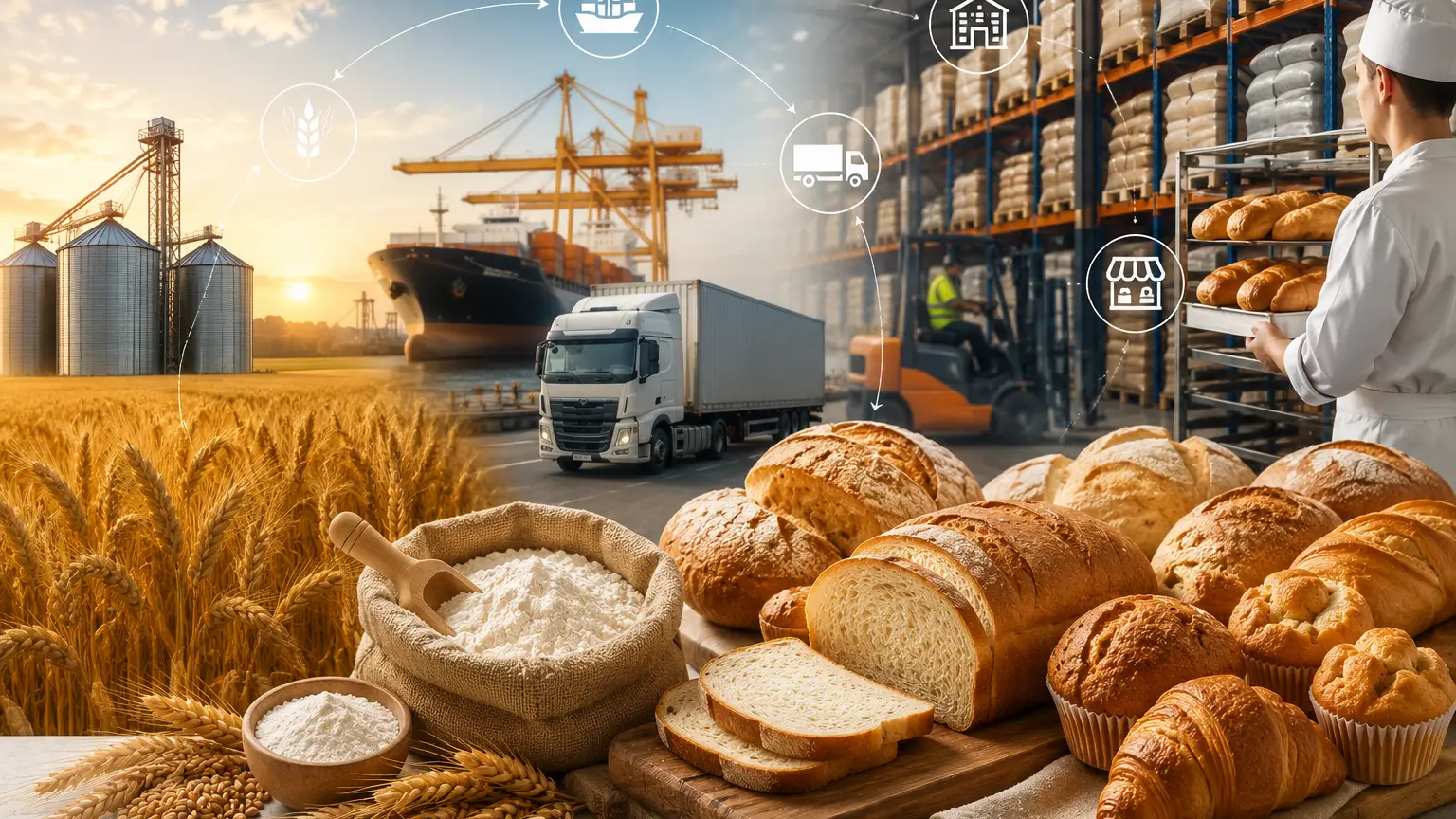
The bakery meal supply chain starts with the collection of bakery-derived material and continues through separation, processing, drying, quality control, packaging, warehousing, and distribution. Because the feed ingredient originates from multiple potential bakery streams, consistent supplier management is important to maintain an appropriate commercial specification across shipments.
For manufacturers and traders, supply reliability depends on more than physical availability. A workable supply program needs predictable specifications, suitable packaging, appropriate storage conditions, documentation, and logistics coordination. The Tradeasia product information identifies United States origin, HS code 230990, 50 kg packaging, and a six-month shelf life, giving international buyers several starting points for evaluating import and distribution requirements. \
The commercial opportunity extends beyond feed mills. Ingredient distributors can use bakery meal as part of a broader feed-ingredient portfolio, while manufacturers can assess it where energy contribution, formulation flexibility, and alternative sourcing are commercially relevant. The product's classification within by-products and energy sources reinforces its position as a functional feed material rather than simply a waste-management output.
For Tradeasia and the broader Chemtradeasia marketplace ecosystem, the strongest positioning is therefore information-led sourcing. A marketplace can help buyers move from discovery to inquiry by presenting product specifications, application information, documentation availability, packaging details, and supplier contact pathways in one procurement context. This reduces the information gap between technical evaluation and commercial sourcing without overstating the product's suitability for every feed formulation.
Strategic Outlook for Bakery Meal Buyers
Making Sourcing Decisions with Better Market Intelligence
Bakery meal occupies an increasingly relevant position at the intersection of feed economics, alternative ingredient sourcing, and circular agrifood systems. Its established use in poultry and swine feed, together with applications across other livestock categories, gives the material a practical role in compound-feed procurement. However, its commercial value depends on how effectively buyers match the ingredient specification with their formulation objectives.
The most important procurement trend is a shift from simple price comparison toward total sourcing evaluation. Buyers need to consider nutrient consistency, moisture, physical form, microbiological quality, contaminants, packaging, shelf life, origin, regulatory status, and delivery reliability together. This approach is consistent with the broader food-safety direction identified by FAO and EFSA, where circular use of food by-products must be supported by appropriate risk management.
Manufacturers, distributors, and traders can also benefit from application-specific sourcing strategies. A buyer focused on poultry or swine feed may prioritize energy contribution and formulation economics, while a distributor may place greater weight on documentation, packaging, inventory turnover, and customer specifications. Treating these requirements as part of the sourcing brief helps procurement teams identify suppliers that can support repeat business rather than only one-off transactions.
For organizations evaluating bakery meal suppliers, the next step is to compare the available technical information with internal feed specifications and commercial requirements. Tradeasia's Bakery Meal supplier information provides a starting point for reviewing the product's stated characteristics and initiating a B2B inquiry. As demand for resource-efficient feed ingredients develops, buyers that combine application knowledge, quality verification, and supply-chain discipline will be better positioned to evaluate bakery meal opportunities.
Sources
- Food and Agriculture Organization — Ensuring food safety in a circular economy — 2024 overview of circular agrifood systems, food by-products, and associated safety considerations.
- European Food Safety Authority — Chemical contaminants in food and feed — current scientific and regulatory context for contaminants relevant to feed safety.
- Sustainability — Integrated methodology for sustainable valorisation of bakery former food products as pig feed — 2023 research examining bakery meal production, traceability, safety analysis, and pig-feed application.
Leave a Comment