Bakery Meal Market Context and Commercial Opportunity
From bakery by-product to feed ingredient
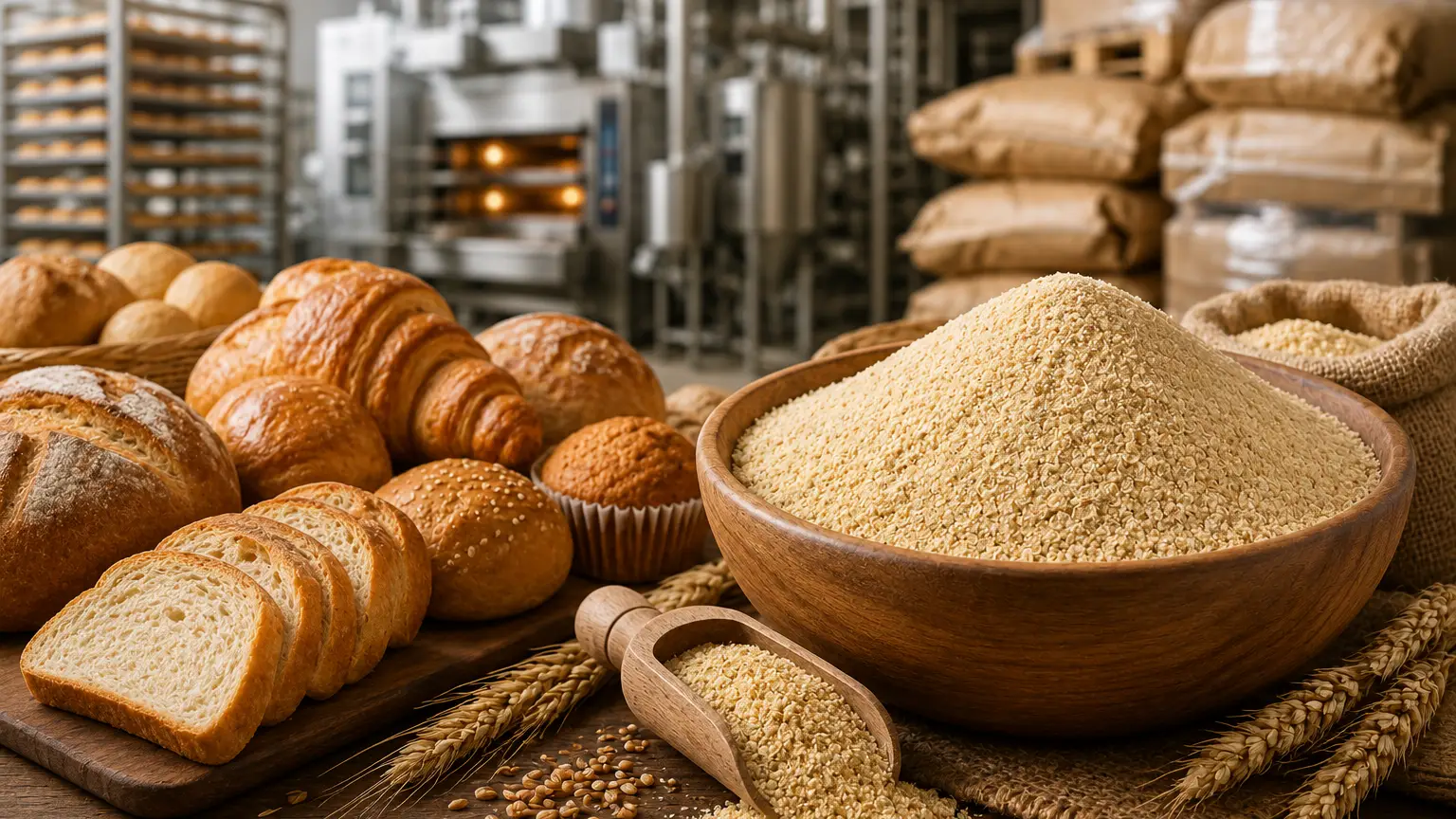
Bakery Meal occupies an increasingly relevant position within the broader market for recovered food ingredients and alternative animal feed materials. The product page describes it as a dried bakery by-product consisting of materials such as bread, chips, crackers, cookies, cereals and other baked goods that are no longer intended for human consumption. The listed product is feed grade, originates from the United States, and is supplied as a light-brown powder or crumbles.
The commercial importance of this category extends beyond simple waste management. Research published in Sustainability describes dried Bakery Meal as a composite feed ingredient produced from former food products through processes such as blending, grinding and dehydration, creating a pathway for food materials to return to the animal-feed supply chain. This reflects the broader circular-bioeconomy movement, where food-industry co-products are increasingly assessed according to their recoverable nutritional and economic value.
Why circular feed sourcing matters
For feed manufacturers, the attraction of Bakery Meal is closely connected to its composition and application flexibility. The product information indicates carbohydrates of approximately 55–62% on a dry-matter basis, fat of 7–10%, and crude protein of 10–14%. These characteristics make Bakery Meal particularly relevant where formulators are seeking energy-contributing feed materials that can complement conventional ingredients.
The wider market context is also supportive of resource recovery. The 2024 Food Waste Index emphasizes the need to move from measuring food waste toward practical reduction and resource-management solutions, while research in Animal highlights the increasing role of food-industry co-products and other low-opportunity-cost materials in more circular animal-feed systems. For B2B buyers, this means Bakery Meal can be evaluated not only as a feed ingredient, but also as part of a more diversified sourcing strategy.
Bakery Meal Applications in Animal Feed
Poultry feed applications
Poultry is one of the principal end-use segments for Bakery Meal. The product information identifies poultry feeding as a common application, while scientific literature has examined bakery-derived materials as alternative ingredients in poultry rations. A review published through the Indian Council of Agricultural Research's Indian Journal of Animal Nutrition notes that bakery waste can be considered as an unconventional feed ingredient in broiler diets, particularly where producers are evaluating alternatives to conventional feed materials.
The formulation rationale is primarily connected with energy contribution and ingredient economics rather than treating Bakery Meal as a universal replacement for any individual raw material. Its carbohydrate and fat profile can influence the energy density of a finished ration, while its actual nutritional contribution depends on composition, processing and inclusion level. Consequently, poultry feed manufacturers should assess each supply according to laboratory specifications and formulation objectives rather than relying solely on generic Bakery Meal averages.
Pig feed applications
Pig nutrition is another major application area. Research on Bakery Meal in pig production describes the material as containing meaningful quantities of starch, sugars and oil or fat, making it a potential energy source in pig diets. The same research considers Bakery Meal as an alternative ingredient that can replace part of conventional grain- and protein-based materials, depending on formulation requirements.
This creates a practical commercial opportunity for feed mills serving swine producers, particularly those with access to consistent supplies of processed Bakery Meal. Because ingredient composition can vary according to the mix of bakery products entering the production stream, buyers need dependable specifications and batch consistency. The objective is therefore not simply to locate the lowest-cost Bakery Meal supplier, but to secure material that can be incorporated predictably into feed formulation and production systems.
Buyer Requirements and Procurement Priorities
Who buys Bakery Meal
The core B2B buyer groups include compound-feed manufacturers, poultry-feed producers, swine-feed manufacturers, livestock nutrition companies, ingredient distributors and procurement teams responsible for alternative feed materials. Traders and distributors may also evaluate Bakery Meal when building portfolios of energy sources and food-industry by-products for regional feed customers. These buyers typically operate at a different decision-making level from end users because they must consider specifications, supply continuity, documentation and logistics simultaneously.
Demand is therefore influenced by both animal nutrition requirements and commercial sourcing conditions. Feed manufacturers may investigate Bakery Meal when they want additional energy-contributing materials, diversify their raw-material base, or participate in more circular feed systems. Research into recovered food as animal feed emphasizes that nutritional quality, chemical and biological safety, and scalable processing all need to align before recovered food materials can become commercially viable feed inputs.
What procurement teams compare
Procurement teams commonly compare Bakery Meal suppliers on composition, microbiological parameters, moisture, contaminants, packaging, origin, shelf life, certifications, documentation and delivery capability. The listed product specifications include moisture below 12%, total plate count below 500,000 CFU/g, yeast and mould below 50,000 CFU/g, negative Salmonella testing per 25 g, a six-month shelf life, 50 kg PP woven-bag packaging, and feed-grade status.
Supplier comparison becomes particularly important because Bakery Meal is a processed mixture rather than a single agricultural commodity with an inherently uniform composition. Buyers should therefore evaluate the specification sheet, available technical documentation and quality-control procedures alongside price. For buyers researching commercial availability, the Bakery Meal product page provides a starting point for reviewing the listed product characteristics and initiating an inquiry.
Bakery Meal Quality, Processing and Compliance
Processing and storage considerations
Processing has a direct effect on the commercial usability of Bakery Meal. According to the product information, bakery by-products are separated and de-packaged before shredding and drying, with the material dried to approximately 90% dry matter to improve storage characteristics. Other processing approaches, including extrusion, pelletization and ensiling, have also been studied for bakery-derived feed materials.
For buyers, moisture control is particularly relevant because excessive moisture can affect storage stability, handling and microbial quality. The listed Bakery Meal specification sets moisture below 12% and recommends cool, dry and pest-free storage. These details demonstrate why procurement specifications should extend beyond nutritional composition to include physical condition, storage requirements and expected shelf life.
Safety and regulatory requirements
Feed safety is a fundamental sourcing consideration because recovered food products must be appropriately controlled before entering animal nutrition supply chains. The European Commission states that feed businesses are subject to hygiene requirements covering the stages that can affect feed and food safety, including registration, appropriate hygiene practices and HACCP principles. Its current animal-feed guidance also emphasizes that feed must be safe, traceable and produced to appropriate standards.
Regulatory requirements can vary according to destination market, species, feed category and composition, so international buyers should verify applicable local rules before shipment. European Commission guidance specifically addresses the feed use and marketing of food no longer intended for human consumption, illustrating why regulatory status and documentation should be part of a Bakery Meal sourcing assessment. Buyers should confirm relevant certificates, declarations, analytical results and import requirements before finalizing a cross-border transaction.
Sourcing Opportunities and Supplier Selection
Evaluating a Bakery Meal supplier
A reliable Bakery Meal supplier should be assessed against both technical and commercial criteria. Product consistency, documented specifications, quality-control systems, packaging, origin, shelf life and the ability to provide supporting documentation can influence whether the ingredient is practical for long-term procurement. The product listed by Feeding Ingredients Asia specifies ISO/HACCP availability, feed-grade status and certification availability for Halal and Kosher requirements, subject to request.
Supplier evaluation should also consider whether the material matches the buyer's target formulation rather than assuming that every Bakery Meal product has the same nutritional profile. Published research has reported variation across bakery-meal sources, reinforcing the importance of analytical verification. A buyer developing a recurring supply program should therefore establish acceptable ranges for key parameters and use those specifications when comparing quotations from different suppliers.
Building a dependable supply strategy
Supply reliability is particularly important for feed manufacturers because changes in raw-material composition or availability can affect formulation, production planning and cost control. Bakery Meal sourcing can be strengthened through clear specifications, agreed documentation, defined packaging requirements and transparent communication around origin and processing. For distributors, these factors are equally important because downstream customers may require consistent technical information before approving an ingredient.
A B2B marketplace can help streamline the early stages of this process by giving buyers a structured product reference from which to assess technical characteristics and begin supplier discussions. The Bakery Meal supplier information includes product specifications, packaging, storage information and inquiry functionality, helping procurement teams move from general market research toward a more defined sourcing conversation.
Bakery Meal Outlook for Feed Ingredient Buyers
Application-driven demand outlook
The medium-term opportunity for Bakery Meal is closely connected to the continued search for practical feed ingredients that combine nutritional utility with improved resource efficiency. Research on circular food production identifies food-industry co-products as an increasingly important component of future feed systems, while studies specifically examining Bakery Meal show its relevance as an energy-contributing ingredient for pigs and poultry.
This does not mean Bakery Meal will replace conventional feed commodities across all formulations. Instead, its commercial role is better understood as a complementary ingredient whose value depends on local feed economics, formulation requirements, availability and quality consistency. As feed manufacturers increasingly assess alternative ingredients through both nutritional and sustainability criteria, Bakery Meal can remain relevant where its specifications and delivered economics fit the target application.
Commercial opportunity for B2B buyers and suppliers
For manufacturers, traders and distributors, the opportunity lies in connecting a consistent Bakery Meal supply with feed markets where energy contribution, ingredient diversification and food-by-product valorization are commercially relevant. For procurement teams, the priority is to identify suppliers capable of providing predictable quality, appropriate documentation and dependable logistics rather than evaluating price in isolation.
For buyers assessing current supply options, the Bakery Meal sourcing page offers a direct starting point for reviewing the available specification and submitting an inquiry. As feed markets continue to balance cost, nutritional performance, safety and resource efficiency, Bakery Meal represents a commercially relevant category for buyers seeking alternative feed ingredients with established poultry and pig-feed applications.
Sources
- MDPI — Sustainability: Demonstration of an Integrated Methodology for the Sustainable Valorisation of Bakery Former Food Products as a Pig Feed Ingredient: A Circular Bioeconomy Paradigm (2023). Read the MDPI article
- Elsevier — Journal of Cleaner Production: New approaches for safe use of food by-products and biowaste in the feed production chain (2023). Read the ScienceDirect article
- Elsevier — Animal: Review: Composition and utilisation of feed by monogastric animals in the context of circular food production systems (2023). Read the research article
Leave a Comment