Ammonium Polyphosphate Fundamentals and Commercial Role
What Is Ammonium Polyphosphate?
Ammonium polyphosphate (APP) is a family of condensed ammonium phosphate materials in which phosphate units are linked into polyphosphate structures. Commercial APP products can differ substantially in polymerisation degree, crystalline phase, solubility, particle characteristics, and purity, making the product specification particularly important when evaluating industrial supply. A 2025 review in the European Polymer Journal identified multiple APP phases and highlighted their different relationships with fertilizer, fire-retardant, food, and feed applications.
Why Product Grade Matters
From a B2B purchasing perspective, ammonium polyphosphate should not be treated as a single uniform commodity. The performance expected from APP in a fertilizer formulation can differ significantly from the requirements of APP used in a polymer or coating system. Water solubility, hydrolytic stability, thermal behavior, particle size, purity, phase composition, and compatibility with the target formulation can all influence technical suitability and commercial value.
The Dual Commercial Role of APP
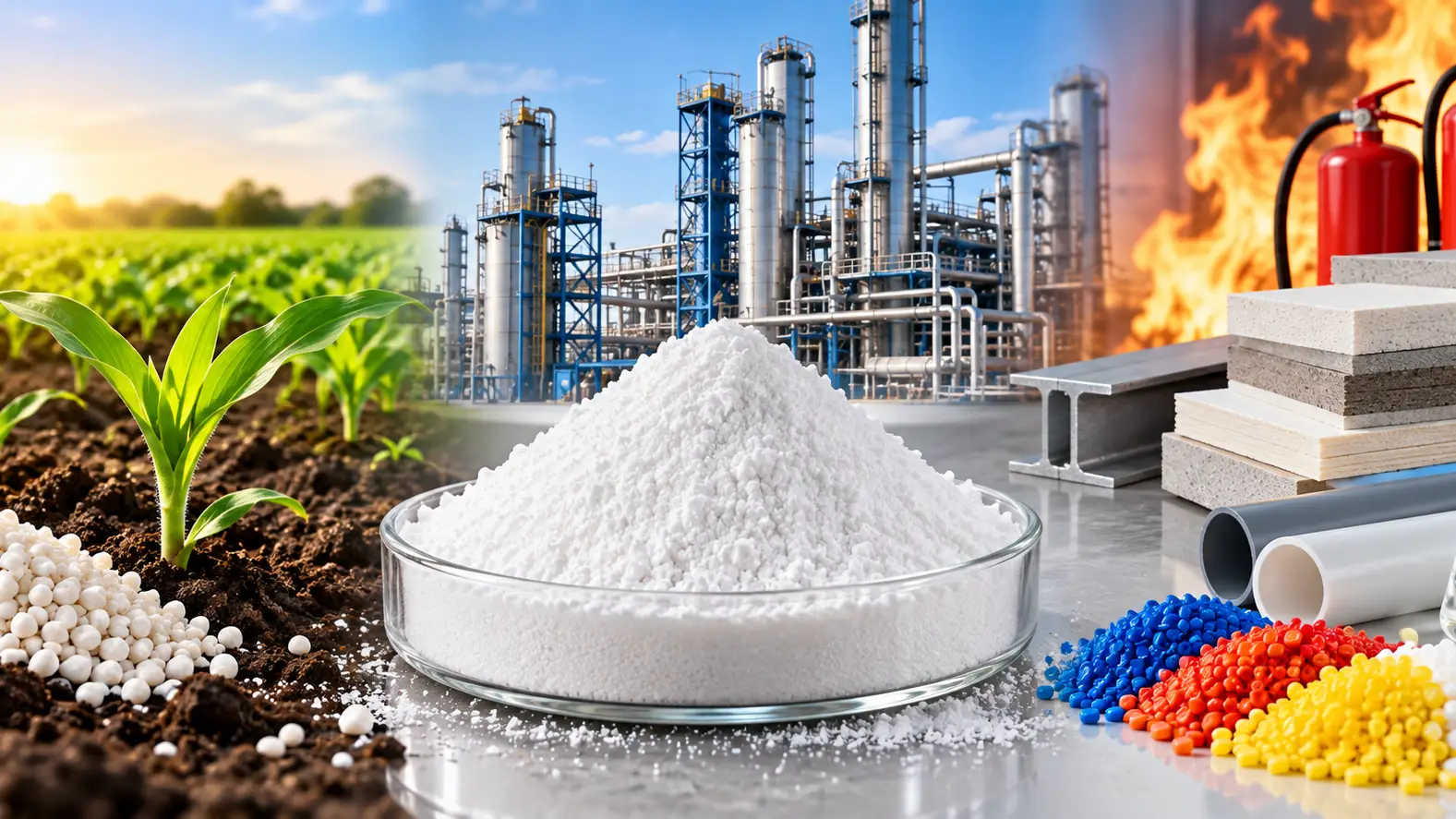
One of the most commercially significant characteristics of APP is its ability to serve different industrial value chains. In agriculture, APP can function as a source of nitrogen and phosphorus, while in materials applications it can act as a phosphorus-based flame-retardant component. This dual role broadens the potential buyer base from fertilizer formulators and agricultural input companies to plastics processors, resin manufacturers, coating producers, and specialty chemical distributors.
Why APP Is Relevant to B2B Chemical Trade
The commercial importance of APP therefore depends not only on its chemical identity but also on its intended end use. Buyers purchasing for agriculture may prioritize nutrient composition, solubility, compatibility with fertigation systems, and regulatory specifications, whereas polymer and coating manufacturers may place greater emphasis on thermal stability, dispersion, moisture resistance, particle size, and compatibility with a resin matrix. For marketplace buyers, this makes application-specific sourcing information essential when comparing suppliers. FAO guidance on fertilizer purchasing similarly emphasizes the importance of clearly defined specifications when buying fertilizers in international and national markets.
Industrial Applications and End-Use Opportunities
APP in Fertilizer Applications
Ammonium polyphosphate has an established role as a nitrogen-phosphorus fertilizer, particularly where liquid fertilizer systems and nutrient management are important. APP can provide both nitrogen and phosphorus in a concentrated fertilizer formulation, making it relevant to fertilizer manufacturers, agricultural input distributors, and professional crop-production systems. Research indexed through the FAO AGRIS platform has also examined APP as a phosphorus source in different soil and crop environments, reinforcing its continuing relevance in agricultural nutrient management.
APP as a Flame Retardant
A second major application is flame retardancy. APP is widely studied as an inorganic phosphorus-based flame retardant for polymeric materials because it can participate in condensed-phase protective mechanisms. Under appropriate thermal conditions, APP can generate acidic phosphorus species that promote dehydration and char formation, creating a protective barrier that can reduce heat and mass transfer during combustion. Recent research continues to investigate APP systems for unsaturated polyester, epoxy resin, thermoplastics, and other polymer matrices.
APP in Polymers, Resins, and Coatings
The polymer industry represents an important downstream market because APP can be incorporated into polypropylene, polyethylene, engineering plastics, thermoset resins, and composite systems. Its effectiveness is highly dependent on formulation design, dispersion, loading level, processing temperature, and interaction with other flame-retardant components. Research published in 2024 specifically reviewed APP systems in unsaturated polyester resins and highlighted ongoing work involving microencapsulation, surface modification, and synergistic additives to improve compatibility and flame-retardant performance.
Broader Application Opportunities
The application landscape creates opportunities for chemical manufacturers, compounders, masterbatch producers, coating formulators, fertilizer blenders, distributors, and industrial procurement teams. Importantly, the same commercial product category can serve very different specifications depending on its destination market. For example, a buyer seeking APP for an agricultural formulation is likely to assess nutrient characteristics and solution behavior, while a plastics manufacturer may focus more heavily on thermal stability and compatibility. This application segmentation provides a practical foundation for B2B marketplace positioning because buyers can search according to both chemical identity and intended use.
Application Trends Shaping Ammonium Polyphosphate Demand
Movement Toward Functionalized Flame-Retardant Systems
A notable recent application trend is the development of modified or functionalized APP rather than relying exclusively on untreated APP. Researchers are investigating surface modification, microencapsulation, and combinations with synergistic materials to address limitations such as moisture sensitivity, dispersion, compatibility, and mechanical-property trade-offs. A 2024 review of APP in epoxy systems describes functionalization as an active research direction, particularly for improving hydrophobicity, compatibility, thermal behavior, and fire performance.
Growing Attention to Application-Specific Performance
Another trend is greater emphasis on matching APP characteristics to the processing environment. Different APP phases and polymerisation levels can produce different water-solubility and thermal-stability profiles, so a buyer cannot always substitute one grade for another without validating the formulation. The 2025 scientific review of APP specifically identified phase, polymerisation degree, particle size distribution, crystallinity, and purity as characteristics that deserve stronger attention in commercial and technical evaluation.
Agricultural Efficiency and Nutrient Management
In agriculture, application development is increasingly connected with more precise nutrient placement and management. Recent research has examined APP alongside fertigation strategies and different phosphorus sources, while other studies have investigated how APP affects phosphorus availability in soils. These developments do not mean APP is universally superior to other phosphate fertilizers; rather, they demonstrate why soil conditions, crop requirements, application method, and fertilizer formulation should be considered when selecting a phosphorus source.
Implications for Chemical Buyers
For B2B buyers, these trends shift procurement away from simply asking for the lowest APP price toward evaluating performance against the intended application. Manufacturers may increasingly request technical documentation covering particle size, moisture, thermal behavior, solubility, purity, and batch consistency, depending on their formulation. This creates an opportunity for suppliers and chemical marketplaces to differentiate through better technical information, transparent specifications, application guidance, and reliable commercial communication rather than relying only on commodity pricing.
Buyer Intent and Industry Relevance
Who Buys Ammonium Polyphosphate?
The principal buyer groups can be divided according to application. Fertilizer manufacturers, agricultural input companies, crop-nutrition formulators, and distributors represent the agricultural side of demand, while plastics compounders, polymer manufacturers, resin producers, coating formulators, masterbatch companies, and flame-retardant specialists represent the materials side. Specialty chemical traders and industrial distributors can also purchase APP for resale or for serving customers with application-specific requirements.
What Procurement Teams Evaluate
Procurement teams generally need to establish whether the available APP grade matches their technical formulation before moving to commercial comparison. Depending on the application, evaluation can include chemical composition, nutrient content, phosphorus concentration, solubility, particle size, moisture, thermal stability, phase characteristics, purity, packaging, documentation, minimum order quantity, lead time, and logistics. For fertilizer procurement, FAO documentation demonstrates the broader importance of defined product specifications and quality requirements when purchasing fertilizers across markets.
Why Buyers Compare Suppliers
Supplier comparison is particularly important for APP because nominally similar products can behave differently in practical applications. Polymer and coating manufacturers may need consistent dispersion and thermal behavior from batch to batch, while fertilizer buyers may require predictable nutrient content and handling properties. A supplier offering technically appropriate specifications, consistent quality, dependable documentation, and predictable delivery can therefore have greater commercial value than a supplier competing only on headline price.
How a Marketplace Supports Buyer Decisions
A B2B chemical marketplace can simplify this process by connecting product discovery with application information and supplier evaluation. For a Tradeasia, Chemtradeasia, or Tradechem Marketplace listing, the strongest conversion path is not simply presenting the chemical name but helping buyers understand what the product is used for, which industries purchase it, what specifications matter, and what information should be requested before placing an order. This transforms a product page from a basic catalog entry into a sourcing resource for procurement and technical teams.
B2B Sourcing and Supplier Evaluation Guide
Match the Grade to the End Use
The first sourcing principle is to begin with the application rather than the supplier. Buyers should define whether the APP is intended for fertilizer production, flame-retardant polymer compounds, coatings, resins, or another application before comparing available grades. Scientific literature demonstrates that APP properties such as water solubility, hydrolytic stability, thermal stability, polymer compatibility, and phase characteristics can have different importance depending on the final application.
Verify Technical Documentation
Technical documentation is central to professional chemical sourcing. Depending on the use, buyers may request a technical data sheet, certificate of analysis, safety documentation, specification sheet, packaging information, and details concerning physical characteristics. For agricultural applications, nutrient analysis and solution behavior may be critical, whereas materials manufacturers may require information relating to thermal performance, particle distribution, and compatibility. A clear specification enables buyers to make meaningful comparisons rather than evaluating suppliers on price alone.
Evaluate Supply Reliability
Supply reliability is another important procurement consideration because APP may form part of a continuous production process. Manufacturers and distributors need to consider production capacity, minimum order quantities, standard packaging, export experience, lead times, shipment terms, and the supplier's ability to maintain consistent product quality. For international B2B trade, these factors can have a direct impact on landed cost and production continuity, particularly when the chemical is being incorporated into scheduled manufacturing programs.
Compare Total Commercial Value
The most useful supplier comparison therefore combines technical suitability with commercial execution. A lower quoted price may not represent the lowest total cost if the product requires additional formulation adjustments, produces inconsistent results, or creates delays in delivery. Buyers should instead compare specification compliance, quality consistency, documentation, logistics, payment conditions, order flexibility, and supplier responsiveness alongside price. A marketplace that organizes these factors around the buyer's intended application can make the sourcing process more efficient and transparent.
Commercial Positioning and Market Outlook
Why APP Has Commercial Relevance
Ammonium polyphosphate occupies a commercially interesting position because it participates in two major industrial value chains: nutrient supply and material fire protection. The fertilizer application connects APP with agricultural productivity and nutrient management, while flame-retardant applications connect it with polymer engineering, coatings, resins, and composite materials. The breadth of these applications creates multiple potential routes to market for manufacturers, distributors, and specialty chemical suppliers.
Where Future Application Development Is Emerging
Recent scientific activity suggests that future value creation is likely to come increasingly from application-specific APP systems. In flame-retardant materials, research is focused on improving compatibility, reducing drawbacks associated with conventional APP, and developing functionalized systems that work efficiently within particular polymers or resins. The 2024 literature on epoxy systems and unsaturated polyester applications illustrates this movement toward engineered APP formulations rather than treating the material solely as a standard additive.
Opportunities for Manufacturers and Distributors
For manufacturers and distributors, this environment creates opportunities to segment the market by end use, technical requirement, and geography. Agricultural customers may be reached through fertilizer and crop-nutrition channels, while industrial-material customers can be approached through plastics, coatings, composites, resins, and flame-retardant supply chains. Clear differentiation between these applications can make product discovery more relevant and help commercial teams communicate the correct specifications to each buyer group.
Marketplace Positioning for Tradeasia
For Tradeasia, Chemtradeasia, or Tradechem Marketplace, APP can be positioned as an application-led B2B chemical product rather than simply a catalog commodity. A strong marketplace presence should connect the product with its principal industrial uses, explain the characteristics buyers need to evaluate, and provide a straightforward route for supplier inquiries and sourcing discussions. This approach supports procurement teams at the research stage while also giving qualified manufacturers, traders, and distributors a more targeted commercial channel.
Conclusion: Turning Application Demand Into Sourcing Opportunities
From Chemical Product to Industrial Solution
Ammonium polyphosphate is commercially relevant because its value extends beyond its chemical composition. Its applications as a nitrogen-phosphorus fertilizer and phosphorus-based flame-retardant component place it across agricultural, polymer, resin, coating, and specialty chemical value chains. Recent research continues to expand understanding of APP structure, phase behavior, formulation compatibility, and application-specific performance, reinforcing the importance of technical selection.
What Buyers Should Prioritize
For buyers, the most important step is to define the intended application before selecting a supplier. Once the end-use requirement is established, procurement teams can compare appropriate APP grades using relevant technical specifications, documentation, quality consistency, logistics, and commercial terms. This application-first approach reduces the risk of choosing a product that appears competitive on price but does not perform as required in the final formulation.
What Suppliers Should Communicate
Suppliers can improve commercial conversion by providing information that directly answers buyer questions. Clear product specifications, application information, packaging details, quality documentation, supply capabilities, and responsive technical communication can help distinguish a professional supplier from a generic listing. This is particularly valuable for APP because different industrial applications place different demands on product characteristics.
The B2B Sourcing Opportunity
For the Tradeasia, Chemtradeasia, and Tradechem Marketplace ecosystem, ammonium polyphosphate represents an opportunity to connect industrial buyers with relevant chemical supply through application-focused information. By combining product knowledge, buyer-intent content, supplier discovery, and sourcing support, a marketplace can help procurement teams move from researching ammonium polyphosphate applications to identifying suitable commercial supply with greater confidence.
Leave a Comment