
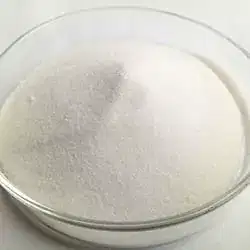
Potassium Citrate Monohydrate (E332)
- IUPAC Name
- tripotassium;2-hydroxypropane-1,2,3-tricarboxylate
- Molecular Formula
- C6H5K3O7
- Molecular Weight (g/mol)
- 306.3900
- InChIKey
- QEEAPRPFLLJWCF-UHFFFAOYSA-K
- InChI
- InChI=1S/C6H8O7.3K/c7-3(8)1-6(13,5(11)12)2-4(9)10;;;/h13H,1-2H2,(H,7,8)(H,9,10)(H,11,12);;;/q;3*+1/p-3
- Synonyms & Trade Names
- TRIPOTASSIUM CITRATE; 866-84-2; Kaliksir; Litocit; Potassium citrate anhydrous; Porekal; Kajos; Urocit K; Seltz-K; K citrate; Citric acid, tripotassium salt; Potassium tribasic citrate; ACALKA; 86R1NVR0HW; 1,2,3-Propanetricarboxylic acid, 2-hydroxy-, tripotassium salt; DTXSID8027325; RefChem:933490; Anhydrous, Potassium Citrate; DTXCID907325; 212-755-5
Categories
Technical Document
Brief Overview Potassium citrate (also known as tripotassium citrate) is a potassium salt of citric acid. It is a white, hygroscopic crystalline powder. It is odorless with a saline taste. It contains 38.3% potassium by mass. In the monohydrate form it is highly hygroscopic and deliquescent. Manufacturing Process Citric acid is first produced using a fermentation process. After fermentation, further processing is required to separate unwanted by-products as well as purify the citric acid itself. Adding potassium hydroxide to citric acid results in the formation of potassium citrate crystals. These crystals are separated from the solution for use as a food additive.