Introduction
Manganese carbonate has emerged as a critical platform chemical in 2026, underpinning a diverse set of industrial value chains ranging from battery materials to agrochemicals. Its versatility stems from its role as a precursor for manganese salts and oxides, enabling downstream production in energy storage, ceramics, and fertilizers. The global manganese carbonate market is witnessing steady expansion, supported by a projected CAGR of 5.8%, with annual production volumes surpassing 320,000 metric tons. Pricing remains moderately volatile, averaging between USD 850–1,200/MT, depending on purity grades and regional supply dynamics.
Battery Materials Driving Structural Demand
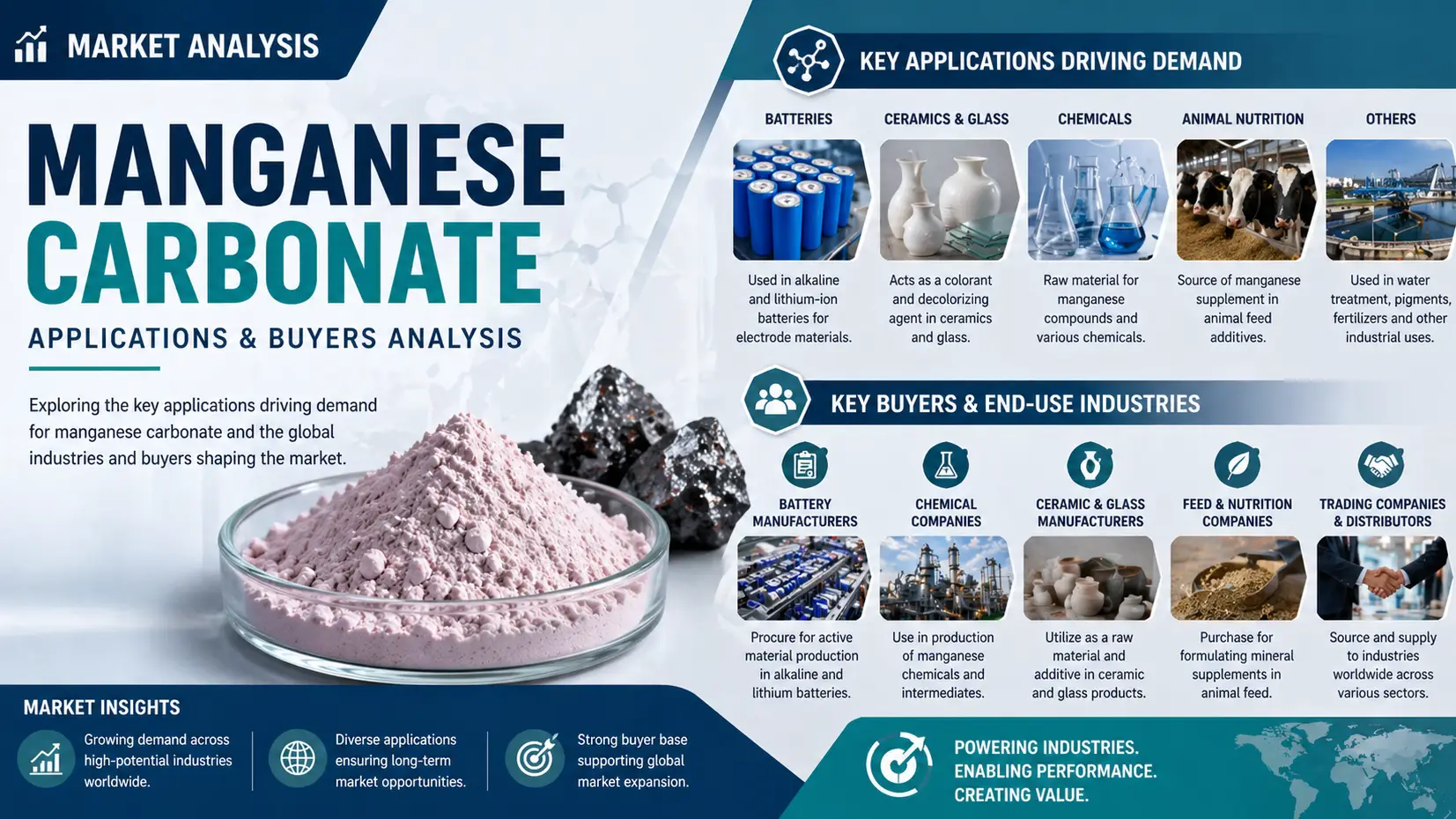
The most transformative application for manganese carbonate lies in lithium-ion battery supply chains. As electric vehicle adoption accelerates, manganese carbonate is increasingly used to produce high-purity manganese sulfate, a key input for cathode chemistries such as NMC (nickel-manganese-cobalt). Battery manufacturers and precursor producers now represent a rapidly growing buyer segment, accounting for nearly 28% of global demand in 2026. Asia-Pacific dominates this landscape, with China alone contributing over 60% of manganese carbonate processing capacity, reinforcing its strategic importance in energy transition supply chains.
Agrochemical Sector and Micronutrient Uptake
In agriculture, manganese carbonate serves as a vital micronutrient additive in fertilizers and animal feed. Its role in correcting manganese deficiencies in soil has become more pronounced amid intensifying crop yield demands. Fertilizer manufacturers and agrochemical distributors remain consistent buyers, particularly in regions like India and Southeast Asia. The segment contributes approximately 22% of total consumption, with stable pricing in the range of USD 800–950/MT for feed-grade material. Demand is further supported by regulatory encouragement for balanced fertilization practices, ensuring sustained volume growth.
Ceramics and Glass Industry Consumption Patterns
The ceramics and glass industries continue to rely on manganese carbonate as a colorant and oxidizing agent. Tile manufacturers, specialty glass producers, and pigment suppliers form a steady buyer base, particularly in construction-driven economies. This segment represents about 18% of global demand, with annual consumption volumes exceeding 55,000 metric tons. While not as high-growth as battery applications, it provides a stable demand floor, especially in the Middle East and Latin America where infrastructure projects remain robust.
Industrial Catalysts and Specialty Chemical Buyers
Beyond mainstream uses, manganese carbonate finds application in catalysts, pharmaceuticals, and specialty chemicals. Chemical processors utilize it as an intermediate in synthesizing manganese-based compounds used in oxidation reactions and fine chemicals. This niche but high-value segment commands premium pricing, often exceeding USD 1,200/MT for high-purity grades. Though representing a smaller share—around 12% of the market—it offers attractive margins and diversification opportunities for producers targeting specialty industries.
Conclusion
As a platform chemical, manganese carbonate continues to bridge traditional industries and emerging technologies, reinforcing its strategic relevance in 2026. From powering next-generation batteries to sustaining agricultural productivity and industrial manufacturing, its demand profile remains both diversified and resilient. Market participants navigating this landscape increasingly seek reliable sourcing, consistent quality, and global logistical capabilities. In this context, Tradeasia International positions itself as a dependable partner, offering integrated supply solutions and market expertise to support evolving buyer requirements across regions.
Sources
-
Manganese Carbonate Market Size & Forecast 2026–2035
-
Manganese Carbonate Market Share, Growth & Industry Analysis
-
Manganese Carbonate Market Trends & Applications 2026
Leave a Comment