Feed Grade Calcium Carbonate Demand and Buyer Trends in Global Livestock Markets
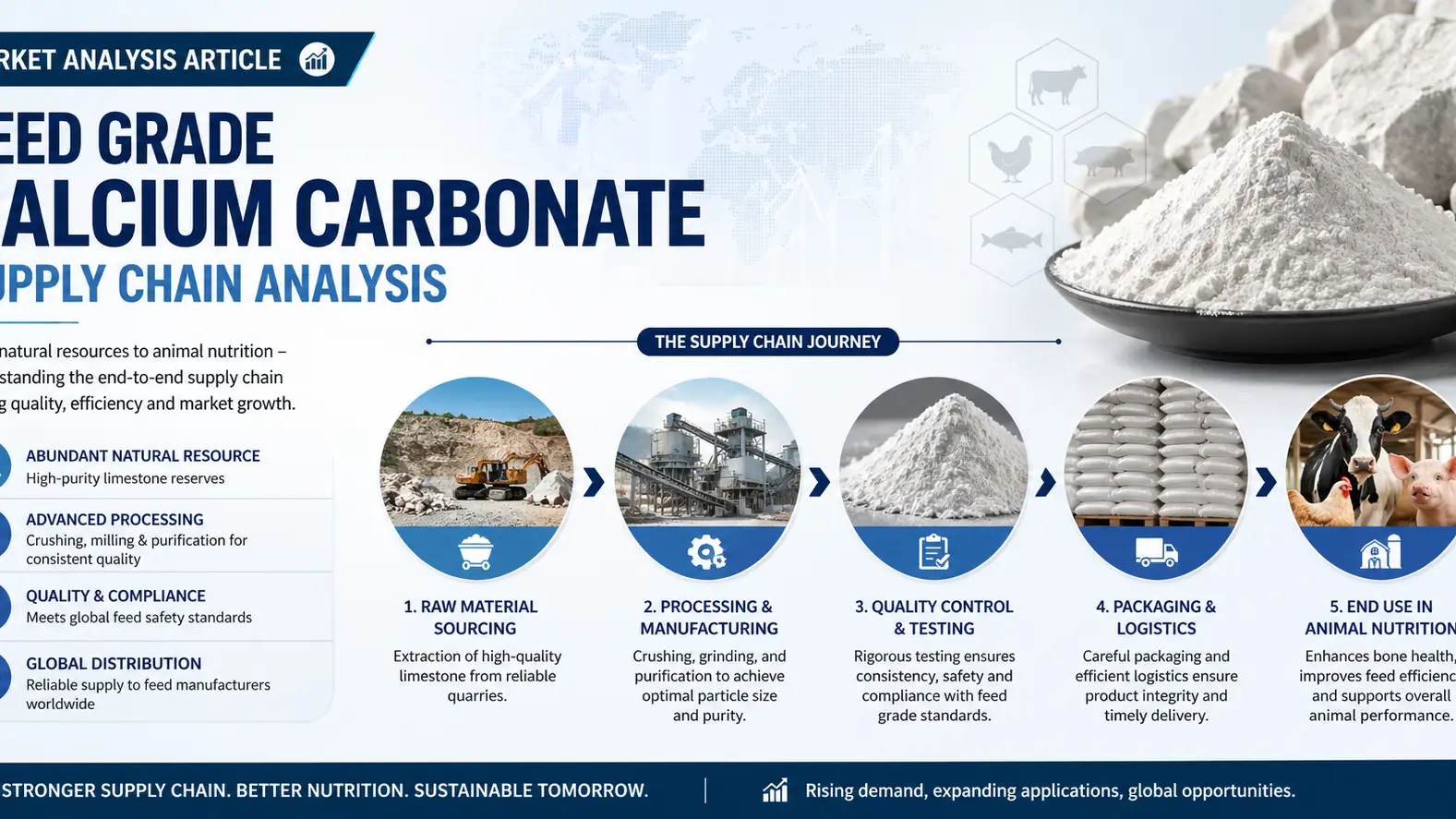
Table of Content
- Feed Formulation Demand from Livestock Intensification
- Cost Efficiency and Price Dynamics in Feed Grade Calcium Carbonate
- Supply Chain and Production Capacity Expansion
- Buyer Landscape: Feed Mills, Integrators, and Premix Manufacturers
Introduction
Feed grade calcium carbonate continues to serve as a foundational mineral supplement in global livestock nutrition systems, supporting skeletal development and optimizing feed efficiency. As of 2026, the market is closely tied to rising protein consumption and industrialized animal farming. Global demand is expanding at a steady CAGR of 4.3%, driven by poultry and swine intensification across Asia and the Middle East. The product remains a cost-effective calcium source, typically traded in the range of USD 70–140/MT, depending on purity and mesh size. Annual production volumes are estimated at over 18 million MT globally for feed applications alone.
Feed Formulation Demand from Livestock Intensification
The primary driver of calcium carbonate feed grade consumption is the rapid intensification of poultry and swine production systems. Feed formulators increasingly rely on precise calcium supplementation to enhance bone strength, egg production, and metabolic stability. Poultry alone accounts for nearly 45% of global consumption, supported by large-scale integration in emerging economies where industrial farming is expanding at double-digit rates in select regions.
Cost Efficiency and Price Dynamics in Feed Grade Calcium Carbonate
Price competitiveness remains a defining factor, with feed manufacturers prioritizing mineral additives that deliver nutritional benefits at low inclusion cost. The average landed price of USD 85–120/MT has remained relatively stable despite fluctuations in energy and freight costs. This stability reinforces calcium carbonate’s role as a strategic filler and nutrient balancer in compound feed formulations.
Supply Chain and Production Capacity Expansion
Global production is concentrated in limestone-rich regions such as China, Vietnam, and parts of Europe, where integrated quarrying and milling operations ensure cost efficiency. Capacity expansion projects have increased output to meet growing export demand, particularly into Southeast Asia and the Gulf region. Logistics optimization and micronized grinding technology are also improving product consistency and reducing contamination risks.
Buyer Landscape: Feed Mills, Integrators, and Premix Manufacturers
Key buyers include commercial feed mills, poultry integrators, and vitamin-mineral premix manufacturers. Large integrators prefer long-term supply contracts to stabilize input costs, while premix companies demand high-purity grades for precision formulations. The shift toward automated feed blending systems is further increasing demand for standardized particle size and certified feed-grade compliance.
Conclusion
Calcium carbonate feed grade remains a strategic platform chemical in global animal nutrition, bridging cost efficiency with essential mineral delivery. Its role is expected to strengthen as livestock production scales further in developing economies. In this evolving landscape, sourcing reliability and quality assurance are becoming decisive competitive factors. Companies seeking consistent supply and technical-grade customization increasingly turn to integrated partners such as Tradeasia International, which supports global buyers with end-to-end chemical distribution solutions and supply chain efficiency across multiple regions.
Sources
-
https://www.imarcgroup.com/calcium-carbonate-market
-
https://www.grandviewresearch.com/industry-analysis/calcium-carbonate-market
-
https://www.usgs.gov/centers/national-minerals-information-center/lime-and-limestone-statistics-and-information
Leave a Comment